

Strategic Arbitrage in Commercial Real Estate: A Comprehensive Framework for Marketing Agile Workspaces and Implementing Building Flexibility
By Robert Kroon
The commercial real estate sector is shifting from static physical assets to vibrant, service-oriented environments. This paradigm shift, often conceptualized as Space-as-a-Service (SaaS), requires asset managers to move beyond traditional long-term leasing structures toward a more sophisticated, three-tier marketing strategy that prioritizes agility, operational excellence, and physical adaptability.1
In today's world, marked by hybrid work models and economic uncertainty, the value of a commercial asset is no longer solely based on its size. Instead, it is increasingly linked to its capacity to enhance productivity, build community, and adapt to the changing needs of its tenants.3
The efficacy of marketing agile workplaces rests upon the integration of agile marketing methodologies, a nuanced understanding of tenant segmentation, and the strategic deployment of modular furniture systems that function as the physical "operating system" of the building.5 By adopting a three-tier model—ranging from shared coworking environments for startups to fully managed enterprise suites for large firms—asset managers can maximize revenue per square foot while mitigating the risks associated with market fluctuations and tenant churn.8
Agile Marketing Methodologies for Asset Management
Before operationalizing the physical space, asset managers must adopt a marketing strategy that reflects the agility of the product they are selling. Agile marketing is not merely a tactical shift but a cultural transformation that prioritizes data-driven insights, iterative testing, and cross-functional collaboration.1 In the context of commercial real estate, this involves moving away from annual marketing plans toward "sprints" that allow for rapid response to vacancy trends and tenant feedback.5
The Architecture of an Agile Marketing Strategy
An effective agile marketing strategy for commercial assets begins with the establishment of a "war-room" team. This multidisciplinary group, comprising leasing agents, property managers, and marketing specialists, aligns on specific goals and expectations, breaking down the traditional silos that often hinder asset performance.5 The core of this methodology is the use of Objective Key Results (OKRs), which provide a framework for translating high-level strategy into measurable outcomes.1
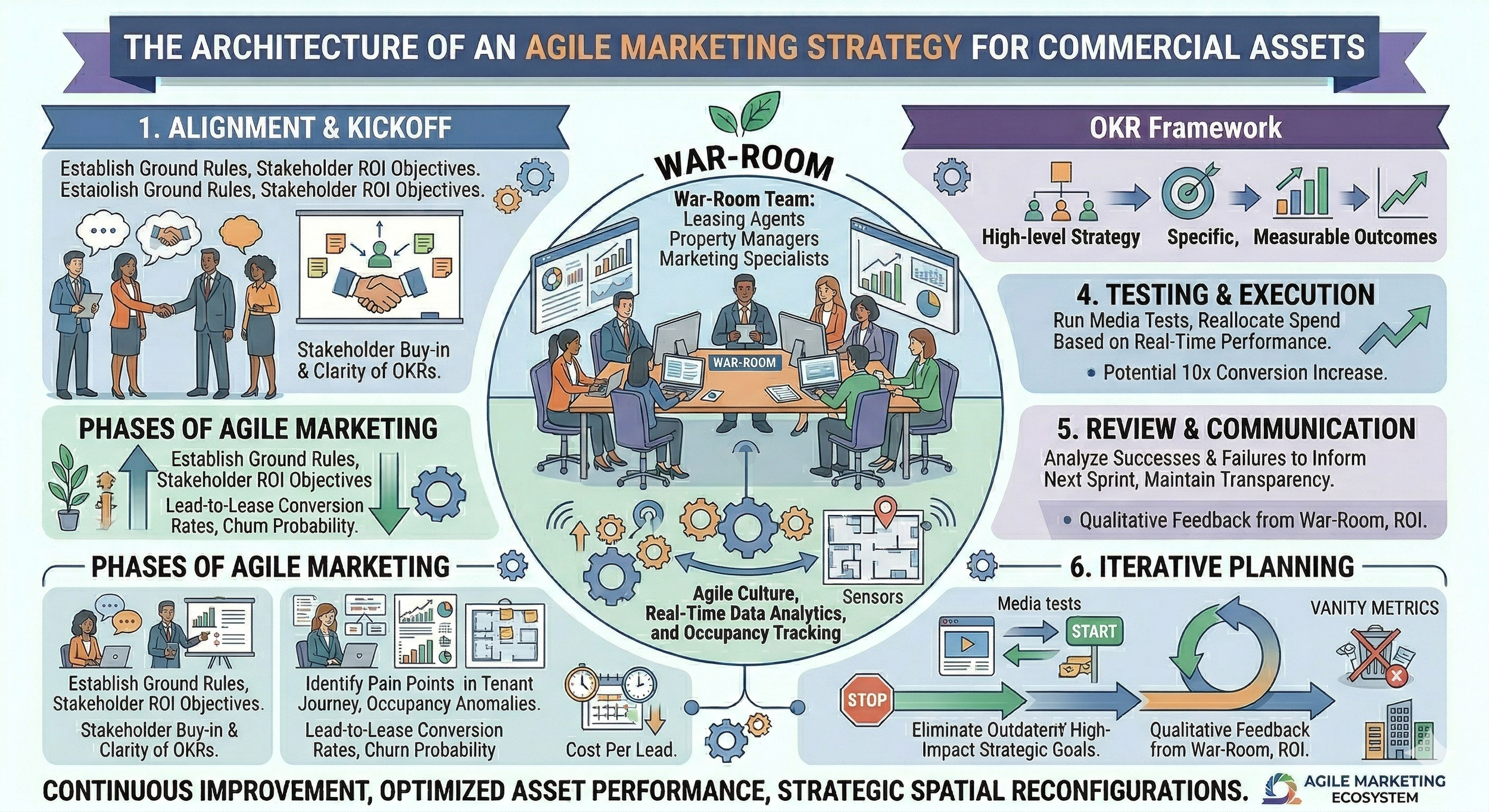
In agile marketing, it’s essential to recognize what to stop doing as much as what to start doing. Asset managers should be prepared to eliminate outdated campaigns that no longer align with current strategic goals, particularly where budgets are limited.1 By utilizing real-time occupancy tracking and data analytics, marketing teams can move beyond "vanity metrics" like social media impressions toward concrete data that informs spatial reconfigurations and leasing tactics.1
The Evolution of the Marketing-Management Link
The integration of marketing and management is essential for meeting the complex needs of modern tenants. This relationship can be understood through the lens of Alderfer’s ERG theory, which suggests that humans—and by extension, the organizations they lead—have three levels of needs: existence, relatedness, and growth.11 A three-tier marketing model for office space maps directly onto these needs, creating a "natural" hierarchy of flexible products.11
Functional marketing addresses existence needs by emphasizing the physical features and cost-effectiveness of the space. Relationship marketing targets relatedness needs by highlighting the community and emotional benefits of the workplace. Finally, innovation marketing meets growth needs by positioning the office as a tool for corporate distinction and unique brand representation.11 These three tiers must work in synergy; focusing on one at the expense of others results in a failure to provide a high degree of satisfaction across the tenant lifecycle.11
Tier One: The Incubation Model—Shared Resources and Short-Term Commitment
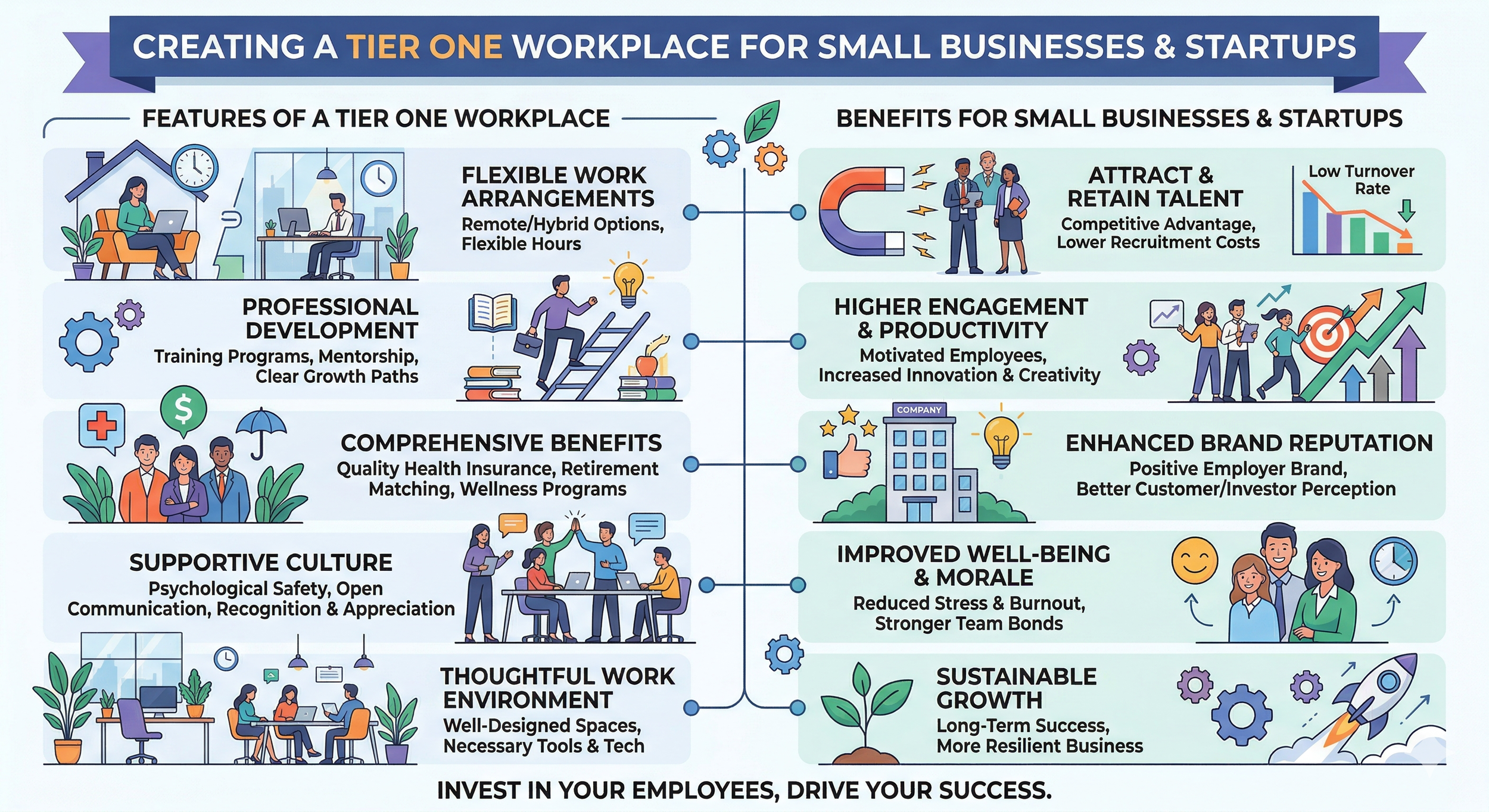
The first tier of the agile marketing strategy targets small businesses, startups, and freelancers who require a low-barrier entry point into professional environments.12 This model is characterized by high levels of resource sharing and minimal commitment, providing the "numerical flexibility" that early-stage companies need to manage capital risk.14
Marketing to the "Agile Startup"
In marketing these spaces, asset managers emphasize the "plug-and-play" nature of the environment. Tenants can often move in within 24 hours, bypassing the lengthy legal and construction processes associated with traditional leases.16 The value proposition centers on affordability and the elimination of upfront capital expenditure (CapEx). Because furniture, IT infrastructure, and utilities are bundled into a single monthly fee, startups can preserve cash for their core business operations.13
The community aspect of coworking is a primary marketing differentiator for this tier. Asset managers market the "collision factor"—the spontaneous networking and collaboration that occur in shared lounges, cafés, and breakout zones.19 These spaces are often described as "playgrounds for creative minds," where the lack of traditional hierarchical boundaries encourages innovation.3
The Strategic Value of the "New Anchor Tenant"
From an asset management perspective, the Tier One offering serves as a "nucleus" for the building. A well-run coworking center drives daily foot traffic and creates an energetic environment that benefits the entire property.9 Furthermore, revenue in this tier is diversified across hundreds of individual memberships, protecting the landlord from the financial shock of a single large tenant vacating.9
However, the operational involvement for this tier is high. Asset managers must transition from passive landlords to active community managers, overseeing hospitality-grade services, curated events, and member churn.8 The "Space-as-a-Service" model in Tier One requires constant marketing to maintain occupancy, as the low commitment level means tenants can exit with minimal notice.15
Tier Two: The Fractional Model—Dedicated Suites and Mid-Level Flexibility
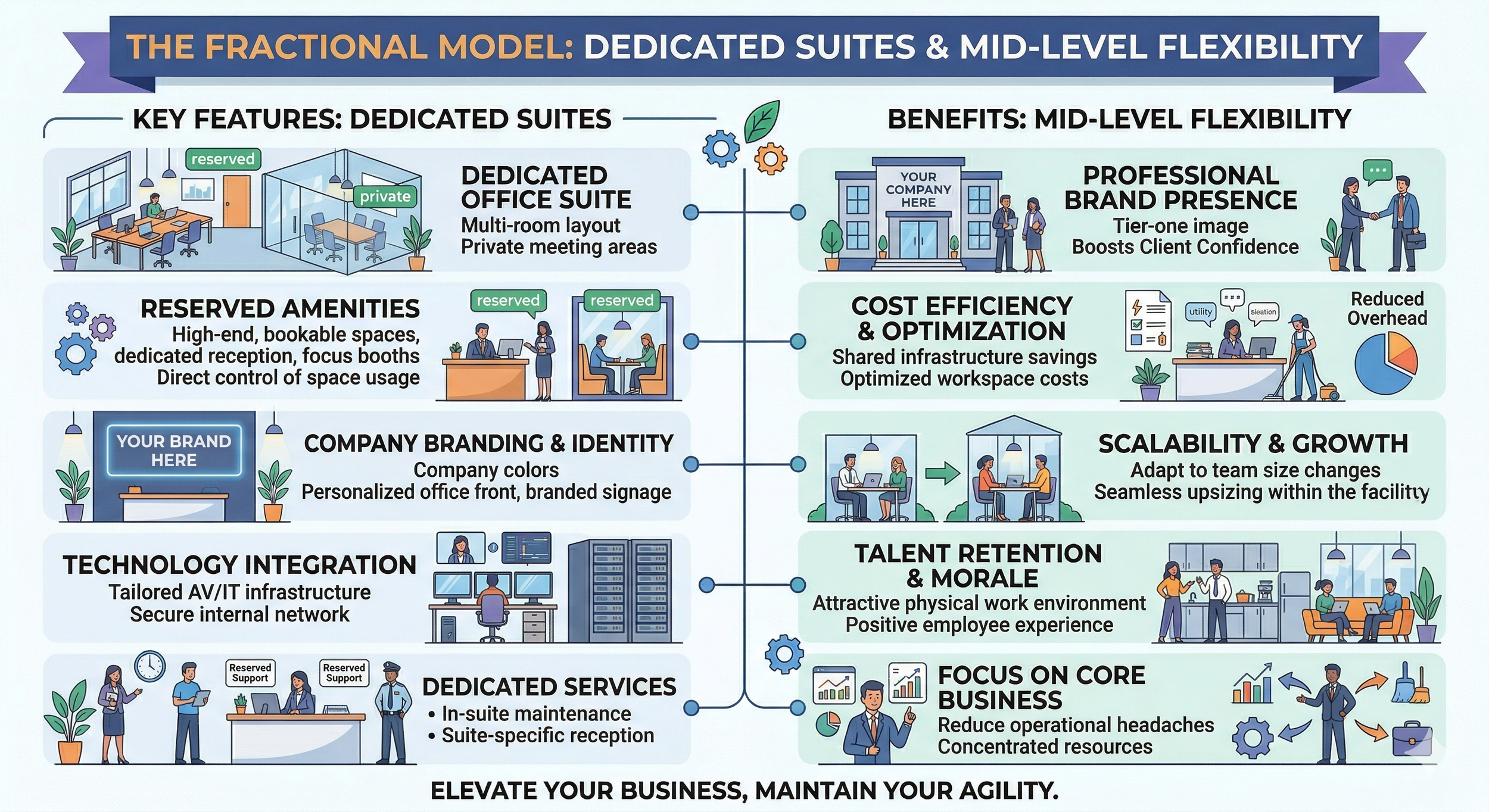
The second tier of the agile strategy targets growing SMEs and mid-sized teams that have outgrown open coworking environments but are not yet ready for a long-term, full-floor traditional lease.21 This model provides a "middle path," offering dedicated, private space—often a fraction or a half-floor—combined with moderate flexibility.12
The Rise of the "Spec Suite"
Marketing for Tier Two centers on the "Spec Suite" (speculative suite) or "Fractional Suite." These are fully designed, pre-built, and furnished office spaces that allow for immediate occupancy.24 In high-demand markets like Washington D.C., spec suites account for a striking 76% of demand for leases under 5,000 square feet, despite making up only 6% of available inventory.24 This discrepancy highlights a profound market preference for move-in-ready convenience over custom build-outs.25
Asset managers market these suites by emphasizing "visual and acoustic privacy." Unlike coworking, these suites are exclusive to one company, ensuring that sensitive data and client conversations remain confidential.12 The marketing narrative shifts from "community" to "team culture," positioning the dedicated suite as a tool for establishing a unique corporate identity.22
Managing the "Flight to Quality"
The Tier Two product is a critical component of a "flight to quality" strategy. Tenants in this segment are increasingly demanding "elevated" workplace experiences, including premium finishes, biophilic design elements, and integrated technology like Zoom Rooms.2 Asset managers can achieve higher revenue per square foot in this tier compared to traditional leases because tenants are willing to pay a premium for the flexibility and the avoidance of initial CapEx.16
However, the economic advantage for the landlord can be eroded by rising construction costs, which have doubled in recent years.24 To maintain profitability, asset managers must implement "adaptable architecture" solutions that allow them to rearrange space for new tenants rather than engaging in expensive, traditional refurbishments.4
Tier Three: The Enterprise Model—Managed Offices and Dedicated FM Teams
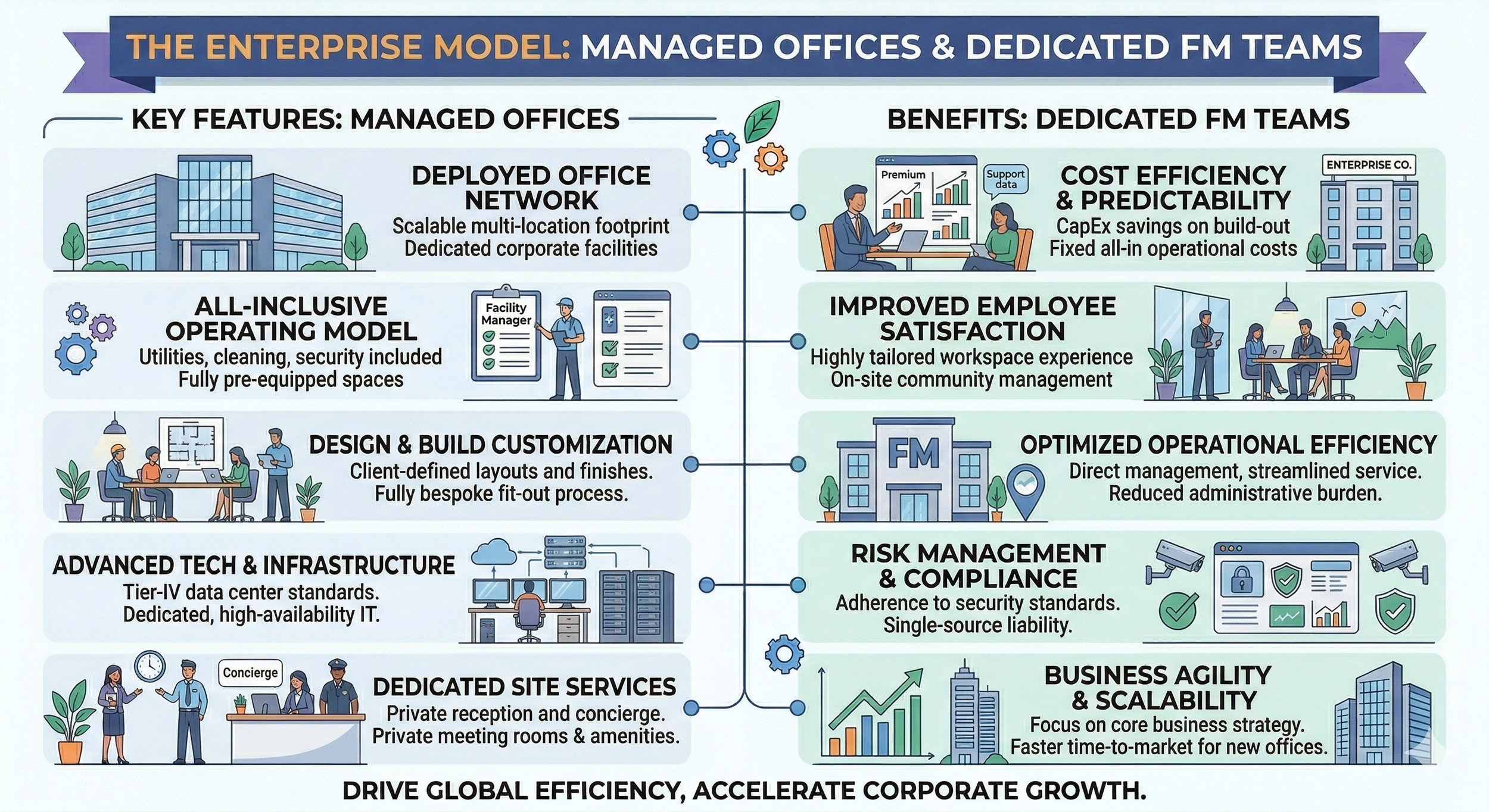
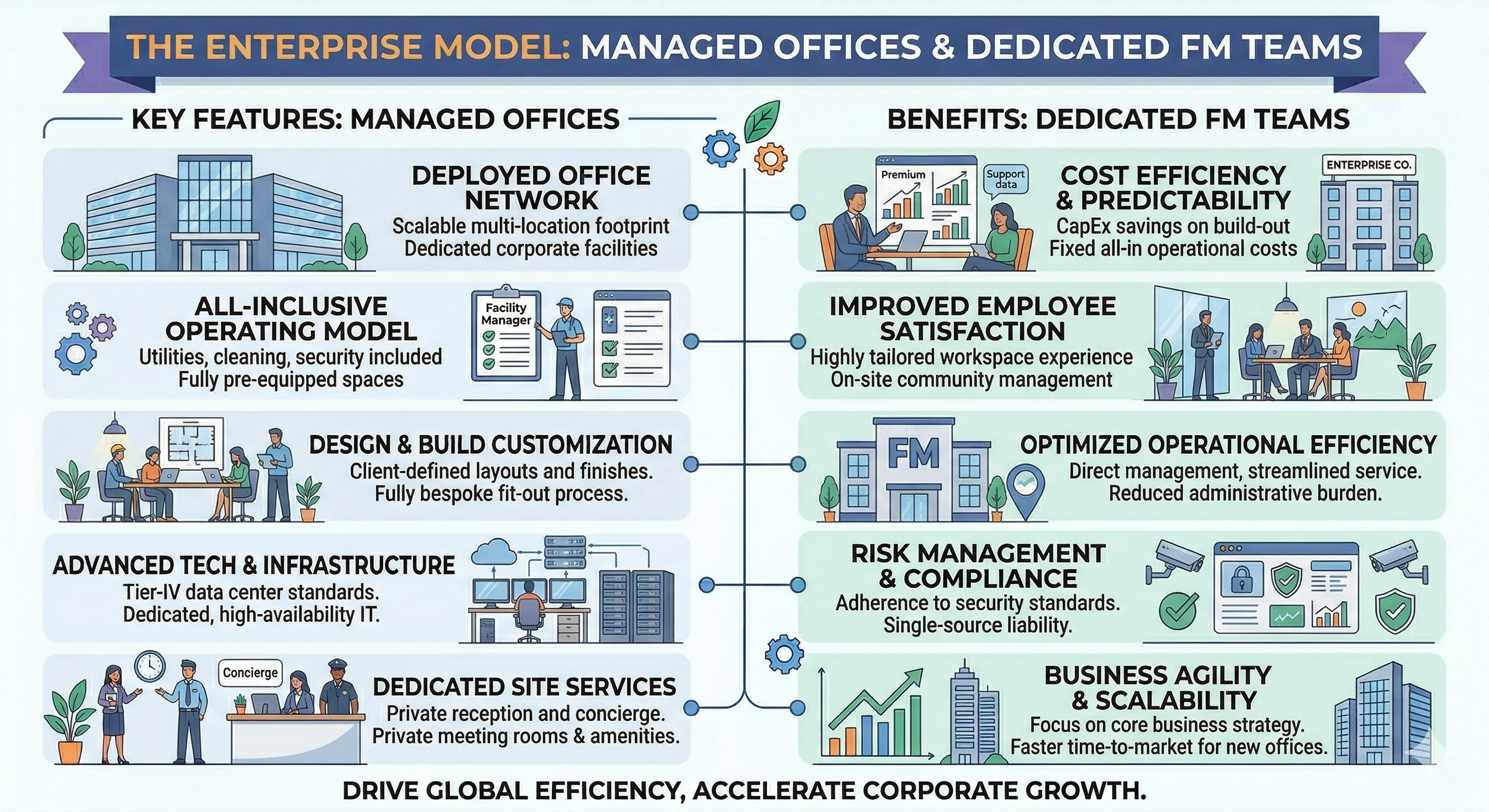
The third and most premium tier of the agile workplace strategy is the managed office. This solution is marketed to established firms and large enterprises that require a fully bespoke, branded environment but want to outsource the operational complexity of the office.12 The defining feature of this tier is the inclusion of a dedicated facilities management (FM) team provided by the landlord or a third-party operator.23
The Value Proposition of Integrated Facilities Management (IFM)
In marketing Tier Three, asset managers move beyond the "four walls" to sell an "Integrated Workplace Experience".28 The marketing focus is on operational continuity and brand reputation. For a Fortune 500 company, a failure in the HVAC system or a security breach is not just an inconvenience; it is a threat to the bottom line.29
A dedicated FM team offers "Hard FM" (technical infrastructure) and "Soft FM" (human services) optimized for the specific tenant.28 This "hospitality-led" approach improves occupant satisfaction and productivity, making the office a high-performance tool for the business.3
Marketing "Focus over Friction"
The primary marketing hook for Tier Three is the elimination of "operational friction." Established companies can focus entirely on their core business while the dedicated FM team handles vendor coordination, maintenance, and daily housekeeping.22 These spaces are "fully operational from day one," providing a turnkey solution that includes custom interiors and branded entries.21
Managed offices typically involve longer-term commitments (1–5 years) than coworking, but they remain more flexible than traditional leases because they often allow for expansion within the building and have shorter lock-in periods than 10-year institutional leases.18 This balance of "ownership" and "flexibility" makes Tier Three particularly attractive to growth-stage companies and international firms setting up regional headquarters.12
Agile Workplace Furniture: The Physical Catalyst for Strategic Flexibility
The three-tier marketing strategy described above is only sustainable if the physical building can adapt to different tenant profiles without incurring prohibitive costs. Traditional office construction—characterized by fixed drywall, rigid wiring, and immobile furniture—is an obstacle to agility.4 Agile workplace furniture and modular architecture serve as the technological catalysts that allow an asset to transition between these tiers seamlessly.6
Enabling the Transition Between Models
Agile furniture allows asset managers to reconfigure a floor plate from a Tier One coworking layout to a Tier Two fractional suite overnight. Agile battery-powered workstations can be arranged in various layouts, supporting both the individual "heads-down" work typical of small startups and the "war-room" collaborative sessions required by enterprise project teams.35
The mechanical flexibility of these systems is the key to their value. Modular desks connect, extend, or rearrange like "office Lego," allowing managers to add seats for a growing tenant without replacing existing furniture.7 This scalability ensures that the landlord’s investment continues to serve the building’s needs over multiple tenant lifecycles.35
Sustainability and the "Circular Business Model"
A significant marketing tactic for agile workplaces involves emphasizing environmental, social, and governance (ESG) benefits. Traditional office fit-outs generate massive amounts of waste every time a tenant vacates and the space is "gutted" for the next occupant.4 In contrast, modular furniture systems follow a circular model: components are designed for disassembly, allowing them to be repaired, repurposed, or recycled rather than sent to a landfill.6
Asset managers can leverage this to attract "green-conscious" clients, advertising reduced CO2 emissions and waste.4 Furthermore, adaptable office environments can help properties obtain green certifications like BREEAM or LEED, which take the long-term lifecycle of the building into account.4 This alignment with sustainability goals not only reduces the carbon footprint but also increases the property’s long-term asset value.4
Economic Synergy and Financial Modeling of the Agile Portfolio
The three-tier marketing model creates a diversified revenue stream that is more resilient to economic shocks than traditional commercial real estate portfolios.9 To maximize returns, asset managers must understand the financial interplay between occupancy risk, revenue per square foot, and the cost of flexibility.
Revenue Optimization through Tiered Memberships
While traditional offices offer stable rent over long terms, they often underutilize space because they are built around fixed layouts that sit idle for much of the week.8 Agile workplaces optimize every square foot by repricing and reconfiguring space based on demand data.8 For example, a coworking floor with 120 members can produce more gross income than a similar office space leased to a single tenant, even if the nominal rent per square foot for individual members is lower.8
However, the "service-led" nature of the agile model increases operational costs. Asset managers must manage the "utilization gap" by utilizing data-driven insights to guide furniture placement and configuration decisions.39 AI systems can learn from usage patterns, suggesting improvements that enhance both efficiency and employee satisfaction.39
The Core-Periphery Financial Model
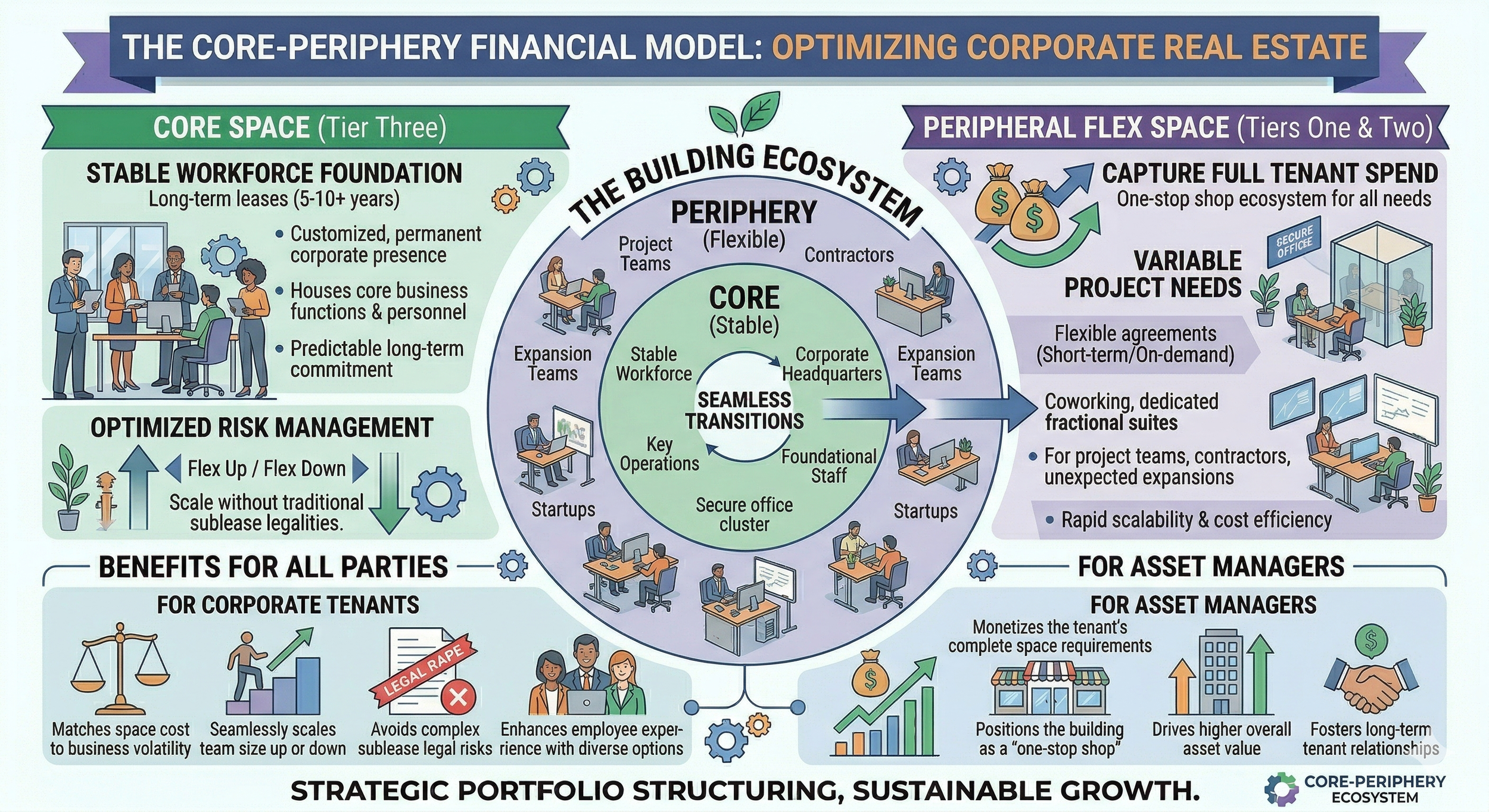
Asset managers can apply the "Core-Periphery" model to help corporate tenants structure their own real estate portfolios. Under this model, a corporation might lease a "core" long-term space (Tier Three) for its stable workforce and utilize "peripheral" flexible space (Tier One and Tier Two) for project teams, short-term contracts, or unexpected expansions.14
Marketing the building as a "one-stop shop" for this entire ecosystem allows the asset manager to capture the tenant’s full spend.23 If a tenant’s team grows, they can expand within the building's flexible tiers; if they need to downsize, they can "flex down" without the legal complications of a traditional sublease.13
Management Agreements: The New Default
A profound structural shift in the industry is the rise of Management Agreements (MAs) over traditional leases.44 In an MA, the landlord and an operator form a partnership. This capital-light structure allows the landlord to retain ownership and benefit from the "operational upside" while the operator provides the brand, marketing, and professional management.44 By 2026, it is predicted that MAs will be the default growth model for the flexible office sector, accounting for over 50% of transactions.44 This shift allows institutional capital to participate in the "Space-as-a-Service" economy without taking on the full operational burden in-house.44
Operationalizing Building Adaptability through Technology
The final pillar of the agile marketing strategy is the integration of technology into the built environment. To market a building as truly "agile," asset managers must prove that the space can respond to user demands in a personalized way.3
Digital Support and Workplace Analytics
Agile environments require software solutions to manage flexible seating and shared resources.3 Marketing materials should highlight features such as:
Smartphone-Accessible Floor Plans: Allowing users to view real-time space usage and reserve desks or meeting rooms on the go.3
Activity-Based Services: Using data from IoT sensors to direct cleaning and maintenance teams only to areas that have actually been used, improving service quality and reducing unnecessary costs.3
Asset Information Models (BIM): Utilizing 3D navigation and asset tagging to make routine inspections and maintenance faster and more detailed.32
Security and Network Segmentation
For Tier Three enterprise tenants, security is a non-negotiable requirement.15 Marketing tactics must address how the building’s technology infrastructure supports network segmentation and data protection. While coworking often utilizes shared Wi-Fi, managed offices allow for dedicated networks, firewalls, and custom access protocols.15 Providing "frictionless" yet secure access via tech-enabled mobile entry is a key differentiator in the flight to quality.2
Future Outlook: The "Intelligent" Adaptive Building
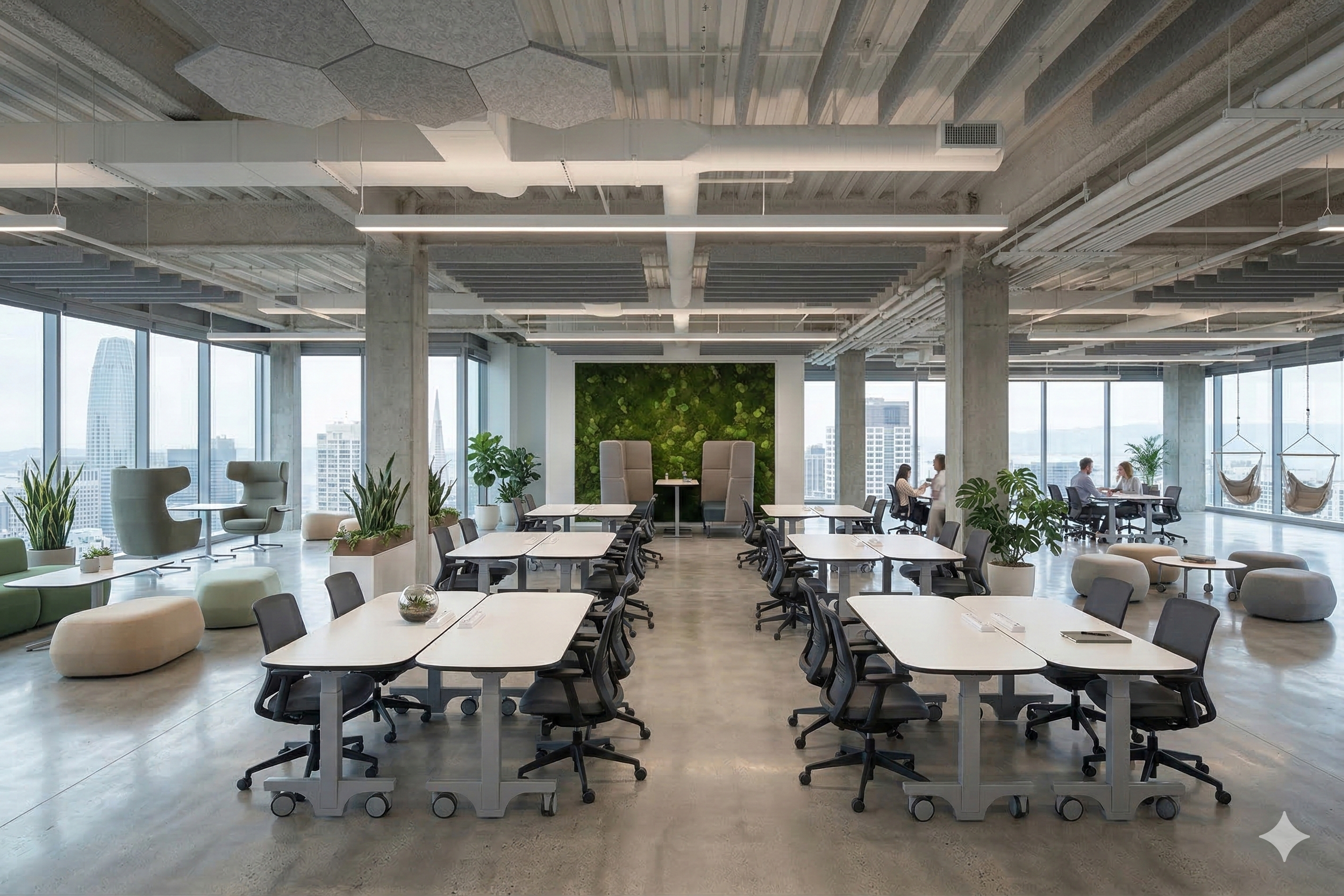
Designed for Agile Workplaces, August Berres products are battery-powered and easily reconfigured.
As we look toward the 2030s, the concept of the agile workplace will continue to evolve. Success will be defined by the ability to achieve "strategic synergy through collaboration"—bringing together different skills, perspectives, and expertise within a single building ecosystem.19
The "3 MAs" (Management Agreements, Managed Offices, and Mergers & Acquisitions) will drive the professionalization of the sector, consolidating the market around a few strong, scalable providers with institutional-grade standards.44 Buildings will increasingly be viewed as "high-performance tools" rather than static containers.3
Asset managers who embrace this three-tier marketing strategy, underpinned by agile furniture and dedicated FM teams, will not only survive the transition to hybrid work but will thrive in it. They will transform their portfolios from bundles of square footage into dynamic environments that empower employees, satisfy corporate growth needs, and deliver superior returns to investors.1
The ultimate goal for an asset manager is to build a "resilient" building. Resiliency is not the ability to withstand change, but the ability to evolve with it.2 By implementing modular interior systems and data-driven management, landlords can quickly adjust to new market realities, ensuring that every square meter of their property continues to deliver value throughout the entire lifecycle of the asset.4
Works cited
5 Game-Changing Agile Marketing Strategies to Achieve More with Less, accessed March 26, 2026, https://www.agilesherpas.com/blog/agile-marketing-strategy
The office: Elevated | JLL, accessed March 26, 2026, https://www.jll.com/en-ca/guides/the-office-elevated
How To Set up an Agile Workspace? | Spacewell, accessed March 26, 2026, https://spacewell.com/resources/blog/how-to-set-up-an-agile-workspace/
Future-Proofing Properties: Adaptability in Commercial Real Estate Market | Mute – Acoustic solutions for good workspace, accessed March 26, 2026, https://www.mute.design/2025/01/09/adaptability-in-commercial-real-estate-market/
Agile marketing: A step-by-step guide - McKinsey, accessed March 26, 2026, https://www.mckinsey.com/capabilities/growth-marketing-and-sales/our-insights/agile-marketing-a-step-by-step-guide
DESIGNING Agile Workspaces with Modular Furniture - Corporate Environments, accessed March 26, 2026, https://corporateenvironments.com/blog/designing/agile/workspaces
Modular Furniture: Adapting to the Flexible Workspace, accessed March 26, 2026, https://adeptoffice.com.au/modular-office-furniture-flexible-workspace/
Office vs. Coworking Space: Returns, Risks, and Cash Flow Compared - LoopNet, accessed March 26, 2026, https://www.loopnet.com/cre-explained/investing/offices-vs-coworking-spaces/
Why Flexible Office is the New Anchor Tenant: How Coworking Drives Building Value in a Post-Hybrid Market - Workspace Strategies, accessed March 26, 2026, https://workspacestrat.com/why-flexible-office-is-the-new-anchor-tenant-how-coworking-drives-building-value-in-a-post-hybrid-market/
The Future of Workplace Agility: Creating Smarter, More Adaptive Spaces, accessed March 26, 2026, https://www.theinstantgroup.com/en-gb/breakthrough-insights/research-articles/the-future-of-workplace-agility-creating-smarter-more-adaptive-spaces/
Hack: What's Three-Tier Marketing - Management Innovation eXchange |, accessed March 26, 2026, https://www.managementexchange.com/hack/three-tier-marketing-0
Coworking vs Flexible vs Managed Office Spaces | Key Differences - BuzzWorks, accessed March 26, 2026, https://buzzworks.co/blog/coworking-vs-flexible-vs-managed-office-spaces/
Coworking vs. Managed vs. Private Offices: A Guide, accessed March 26, 2026, https://vibecoworkingspaces.com/blogs/choosing-between-coworking-managed-private-offices/
CHANGE & FLEXIBILITY The role of serviced office space in office markets and corporate property portfolios - CentAUR, accessed March 26, 2026, https://centaur.reading.ac.uk/27239/1/0199.pdf
Managed vs Serviced Office vs Coworking Based on Risk & Privacy, accessed March 26, 2026, https://www.coworkingcafe.com/blog/managed-office-vs-coworking-vs-serviced-office-how-to-choose-by-risk-and-privacy/
Serviced vs Managed vs Leased Offices: A Comprehensive Guide ..., accessed March 26, 2026, https://hubblehq.com/blog/serviced-managed-leased-offices-differences
NYC Office Space Guide: Comparing Lease, Coworking, and Flexible Options - Hubble HQ, accessed March 26, 2026, https://hubblehq.com/blog/nyc-office-leasing-guide
Comparing Costs: Leased vs Serviced vs Managed vs Coworking — The Hidden Line Items That Change Everything - CoworkingCafe, accessed March 26, 2026, https://www.coworkingcafe.com/blog/leased-vs-serviced-vs-managed-vs-coworking-cost/
Agile Workplace and How to Create Agile Working Environment - Mapsted, accessed March 26, 2026, https://mapsted.com/blog/the-agile-workplace-and-how-to-create-an-agile-work-environment
Rent a Serviced Office Instead of a Traditional Workspace, accessed March 26, 2026, https://venturex.com/blog/coworking/why-you-should-rent-a-serviced-office-instead-of-a-traditional-one/
Managed Office Vs Coworking Space: Difference - Awfis, accessed March 26, 2026, https://www.awfis.com/inspiration/workplace-insights/articles/managed-office-vs-coworking-space-difference
BKC Office Spaces Explained: Coworking vs Managed Offices vs ..., accessed March 26, 2026, https://bhiveworkspace.com/bkc-office-spaces-explained-coworking-vs-managed-offices-vs-traditional-leasing/
Coworking vs Managed vs Virtual vs Serviced Offices: Which ..., accessed March 26, 2026, https://canvasoffices.co.uk/news/coworking-vs-managed-vs-virtual-vs-serviced-offices-which-workspace-is-right-for-your-business
Tenants Flock To Prebuilt Office Suites While Landlords Struggle With Costs - Allwork.Space, accessed March 26, 2026, https://allwork.space/2025/10/tenants-flock-to-prebuilt-office-suites-while-landlords-struggle-with-costs/
The Future of Prebuilt Office Spaces - Market Share - NAIOP, accessed March 26, 2026, https://blog.naiop.org/2024/11/the-future-of-prebuilt-office-spaces/
Managed Office vs Coworking Spaces. Which to choose and why? - BHIVE Workspace, accessed March 26, 2026, https://bhiveworkspace.com/managed-office-vs-coworking-spaces-which-to-choose-and-why/
The Sharp 3 Project – Framework Travel Plan, accessed March 26, 2026, https://travelplantoolkit.tfgm.com/docs/best-practice/Manchester%20-%20Sharp3%20FTP.pdf
Facility Management Services - Sodexo, accessed March 26, 2026, https://us.sodexo.com/services/facilities-management-services
Comprehensive Facilities Management Services | TDIndustries, accessed March 26, 2026, https://www.tdindustries.com/facilities-management
Commercial Facilities Management Companies for Enterprise Operations - KBS Services, accessed March 26, 2026, https://www.kbs-services.com/commercial-facilities-management-companies/
Facility Maintenance | Service, accessed March 26, 2026, https://flagshipinc.com/facility-maintenance/
Office Property Management Software - PlanRadar AU, accessed March 26, 2026, https://www.planradar.com/au/industries/office/
Managed Services in Facilities Management: 4 Benefits for Your Business - CheckSammy, accessed March 26, 2026, https://checksammy.com/blog/managed-services-in-facilities-management-4-benefits-for-your-business/
Agile Interiors: A New Frontier for Adaptable Workspaces Design, accessed March 26, 2026, https://ecolutiondesign.com/agile-interiors-adaptable-workspaces/
The Need for Adaptable Furniture for a Dynamic Workspace - Toprail, accessed March 26, 2026, https://www.toprail.com/news/the-need-for-adaptable-furniture-for-a-dynamic-workspace
How modular office furniture enhances workplace flexibility and employee engagement, accessed March 26, 2026, https://www.employee-engagement-trends.com/blog/how-modular-office-furniture-enhances-workplace-flexibility-and-employee-engagement
What is Modular Furniture? The Smart Way to Build a Better Office, accessed March 26, 2026, https://officesolutionsfl.com/what-is-modular-furniture-the-smart-way-to-build-a-better-office/
Modular Office Furniture: Creating Adaptable and Scalable Workspaces, accessed March 26, 2026, https://allbusinesssystems.com/modular-office-furniture-creating-adaptable-and-scalable-workspaces/
Modular Office Furniture: Flexibility Drives Modern Workspaces, accessed March 26, 2026, https://wdigroup.ca/modular-office-furniture-how-flexibility-drives-modern-workspaces/
Modular Office Furniture: Flexible Solutions for Growing Companies, accessed March 26, 2026, https://legacywps.com/blog/modular-office-furniture-flexible-solutions/
August Berres FAQs: Flexible Power for Agile Workplaces & Building ..., accessed March 26, 2026, https://www.augustberres.com/faqs-3
Furniture Rental Solutions for Commercial Real Estate | CORT, accessed March 26, 2026, https://www.cort.com/office-furniture-rental/industries/commercial-real-estate
Adaptable Furniture Solutions for Commercial Real Estate with CORT - YouTube, accessed March 26, 2026, https://www.youtube.com/watch?v=QbiQivrjgkU
3 MAs: Flex Office Predictions 2026 | Spaces to Places, accessed March 26, 2026, https://spacestoplaces.co.uk/blog/three-mas-flex-office-predictions-2026/
Designing Flexibility in the Asset Management Operating Model - Citisoft, accessed March 26, 2026, https://www.citisoft.com/insights/blog/operating-model-flexibility