


Power an Office Without Rewiring the Building
Your building has enough power. Your floor plan doesn't.
How to power a desk that isn't near an outlet
There are seven ways to do it. Each is right in different circumstances.
Core drilling and floor boxes. Cut the slab, run conduit, set a box where the desk goes. Permanent, high capacity, no batteries to manage. It also means permits, inspection, a contractor, and a cost that commonly runs $100 to $200 per square foot. The investment is fixed to the floor plan you have today.
Power poles. Cheaper and faster than drilling. The workstation is still anchored to one spot, and there's a pole in the room.
Under-carpet flat wiring. Flat conductor cable runs across the slab beneath carpet tile, feeding outlets where the desk sits. No drilling and no ceiling loss, which is why it gets specified in buildings where neither is possible. But it's still a fixed path decided in advance; it still requires an electrician, and it commits you to carpet — both the initial cost and the replacement cycle. Every tile removed for cleaning, repair, or a layout change exposes a cable run that has to be relaid.
Busway. Overhead distribution with drop points along the run. Efficient on large open floors with repeatable layouts, and a serious capital commitment. Still a fixed path.
Raised access floors. A structural floor built above the slab, carrying power and data in the plenum below. Once installed, outlets are relocated by lifting a tile. But the wiring underneath is conventional — electrician, conduit, circuits, inspection — so the raised floor is an added cost on top of a conventional installation, not a substitute for one. Total capital outlay is the highest among all options here. It also takes at least six inches of clear ceiling, which in existing buildings, where floor-to-floor was set decades ago and is often already tight, is the height the asset can't spare.
Power over Ethernet. Genuinely good for lighting, sensors, and fixed low-draw devices. A PoE desk is still connected by a cable, so it doesn't move during the workday, and the available power per port constrains what you can run.
Battery-powered Agile Furniture. No construction, no permits, no circuit work. The equipment is an asset that moves between floors, between suites, and to the next building at the end of the lease. The trade-offs are real: batteries have to be swapped, someone owns that routine, and continuous output per kit is 200W, so sustained high-draw positions belong on fault-managed power or conventional circuits instead.
Where we fit. Raised floors and battery power are the only two options here that let a floor plan change after it's built. A raised floor buys that flexibility at the highest capital cost on this list — conventional wiring plus the floor above it — and six inches of ceiling. We buy it with a battery-swap routine and a 200W ceiling per position. On most existing buildings, that trade favors us. On new construction, where the floor can be designed from the start and there is enough height available, it may not.
Beyond that, most floors have a handful of positions drawing heavily and a large majority drawing very little. Fault-managed power handles the few. August Berres handles the many — the seats where a conventional retrofit costs more than the seat is worth.
C-Power
Where the power comes from
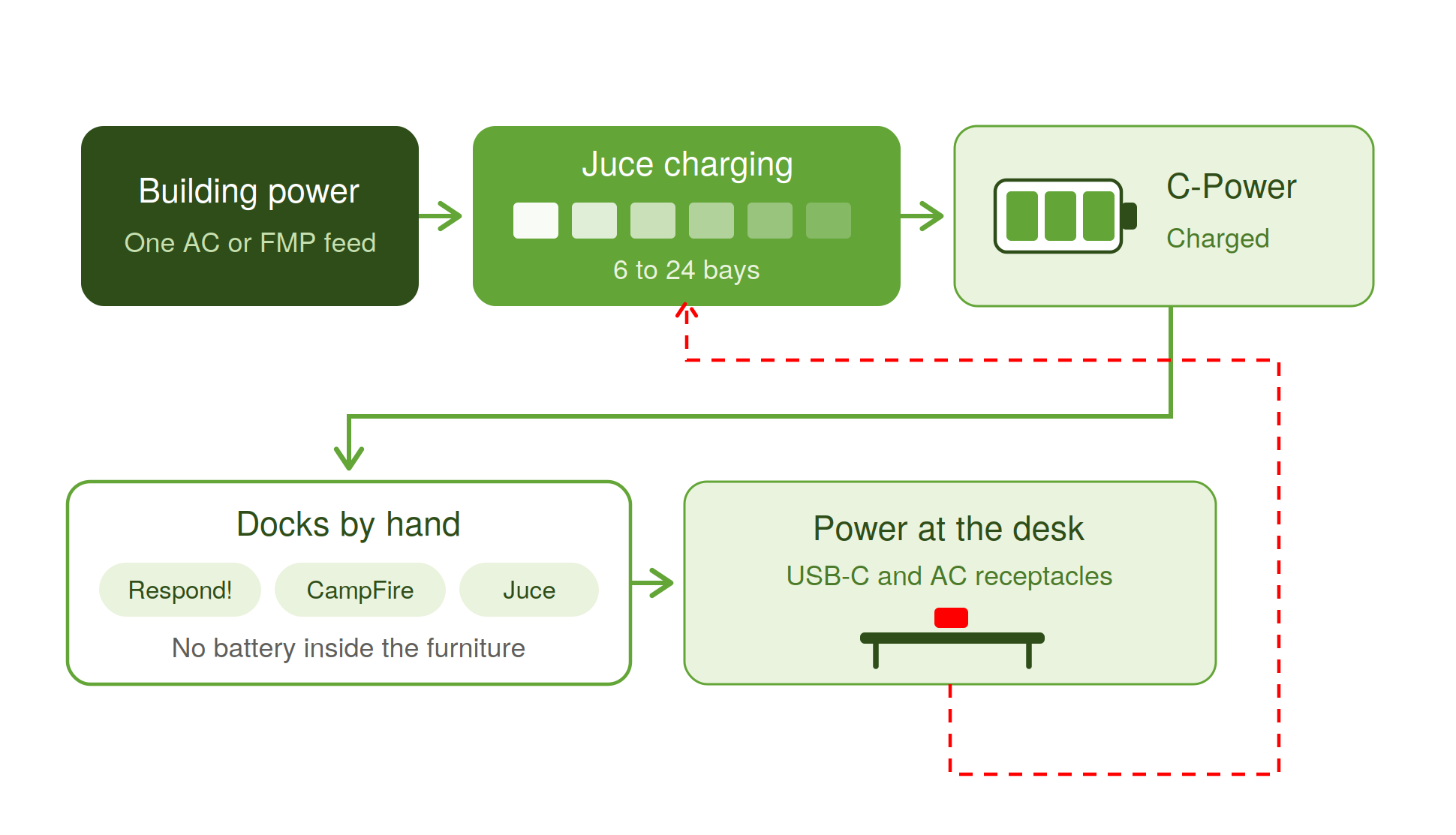
C-Power is a 3.5 lb portable battery pack. It docks by hand into Respond! desks, CampFire desks, and Juce delivery units to supply power at the work surface, and it lifts out just as easily to carry power wherever it's needed. Four GST08 connectors and dual USB-C ports run laptops, monitors, and sit/stand motors from 200 watt-hours of usable capacity.
None of the delivery products has a battery inside — that's deliberate. A system with a built-in battery is out of service while it charges.
When a C-Power pack runs low, someone swaps it for a charged one from a Juce charging cart, and the workstation keeps running. Sustained high-draw positions are better served by fault-managed power; C-Power covers the seats around them.
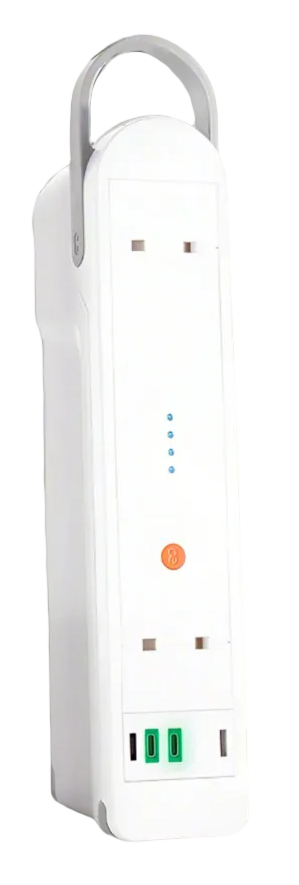
C-Power. 200Wh usable capacity, 3.5 lbs, rated for 2,500 charge cycles over a 7-year service life. Docks into furniture by hand, or carries as a portable supply.
Respond!
The heavy-duty desk
Respond! is built for a workstation that stays busy: sit/stand consoles and desks on casters, with the power system conveniently located on the right-hand side of the desktop. One USB-C and one AC receptacle sit on the work surface; three NEMA receptacles are underneath.
A raceway runs along the underside and exits topside at the rear, which is the pathway for multiple monitors — the thing that usually forces a desk back against a wall and an outlet. Power comes from a docked C-Power pack, so the desk rolls where the org chart needs it, and the power goes along.

Respond! desks place power where people sit, rather than where the outlets happen to be.
CampFire
Tables for rooms where a group works together
CampFire desks include a power system that converts a docked C-Power pack into AC and USB-C power at the desktop. Each kit uses a pure sine wave inverter—the waveform laptops and monitors need—to feed two desktop receptacles, each with a NEMA outlet and two USB-C ports delivering up to 60W.
Continuous output is 200W. Seats draw power from the battery instead of floor boxes, so a room can shift from lecture rows to working groups without anyone being tied to the wiring. The same power kit also retrofits third-party desks, with the docking cutout routed on-site using a drawing we provide.

Four CampFire desks clustered for a working session. The presenter is running a display from a Juce mobile monitor stand, in the middle of a floor with no outlets nearby.
Juce
Charging in, power out
Juce covers both directions. Juce charging carts hold 6, 12, 18, or 24 C-Power batteries and need a single AC or fault-managed power connection — no electrician, no new circuit. Any cart recharges its full load overnight, regardless of capacity: each battery draws power at its own pace under its own control, so a full cart takes no longer than a partial one. Heavy-duty casters mean charging capacity moves to existing outlets.
Juce delivery units work the opposite way: a docked C-Power pack outputs power wherever it is required. The line includes a mobile monitor stand that can sit in the middle of a room where no outlet reaches.

A 24-bay Juce charging cart. Twenty-four batteries, one AC outlet, ready by morning.
Engineering, Not Just Manufacturing
Four decisions that shaped the product line:
The batteries aren't in the furniture. Our early products had onboard batteries. The economics don't work — a power system stuck in charging mode is serving no one. Separating the pack from the delivery system means the furniture never stops working.
The chargers don't push power. Each C-Power pack manages its own charge rate and draws what it needs from the supply. That's why a 24-battery Juce cart recharges in the same time as a 6-battery one.
The inverters are pure sine wave. Modified sine is cheaper and perfectly adequate for a power drill. It isn't adequate for a laptop or a monitor, so we don't use it.
One item number per kit. The CampFire Power System has nine components. Nine order lines is nine chances to miss one and find out on installation day.
Everything is built under ISO 9001 and electrically tested before it ships. Charging supplies carry UL/IEC 62368-1; desktop receptacles are BS6396 compliant.
Where to go from here
You have a floorplate to power
Send us the floor plan. We'll come back with what it takes to power it, what it costs, and where conventional wiring is still the better answer.
You're specifying and need documents
Data sheets, installation drawings, and item numbers for C-Power, Respond!, Juce, and CampFire.
You're not ready to talk yet
We write about power constraints in commercial buildings — what's changing, what it costs, and what actually works.