


C-Power
The energy in a workstation, sized to be carried.
Most workplace power problems are not capacity problems.
They are commitment problems. The moment a receptacle is cored into a floor slab, that location becomes a desk — permanently, or until someone pays to move it.
C-Power is the removable energy element of a furniture system built the other way around. It docks into the worksurface, powers what sits on it, and when it runs low, it is exchanged for a charged one. The desk never goes dark, and the floor is never committed.
The swap, in three steps
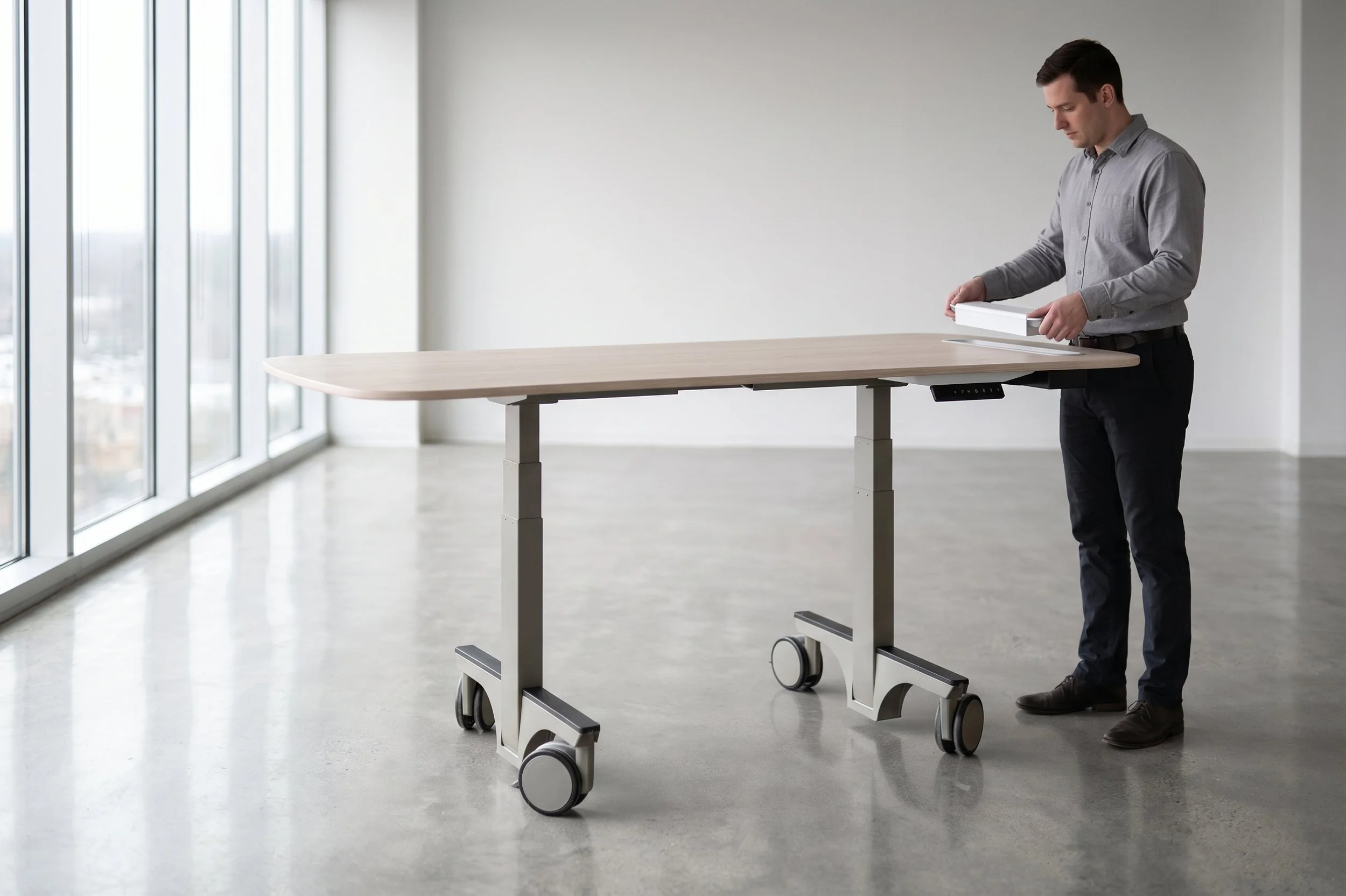
Dock. C-Power seats into the work surface. Power is available at the desk with no cord to a wall.
Swap. When the pack runs low, it lifts out and a charged one goes in. Seconds, no tools, no downtime.
Charge. Depleted packs return to a Juce charging cart. The fleet cycles; the furniture stays put.
Why it is built this way
On a 16,000-square-foot floorplate, for example, somewhere between a third and half of the usable floor is beyond the reach of any wall, column, or core receptacle. Where the core sits decides which. A core in the middle of the plate throws served floor in four directions.
A core at one end — common, since elevators land near the lobby — pushes most of its coverage into the floor the perimeter already reaches, leaving close to 6,500 square feet with nothing near it.
A 16,000 sf floorplate with the core at one end, where elevators usually land. Grey marks the floor within 10 ft of a wall, column, or core. The green 6,500 sf can only be powered by cutting into the slab.

We sized it for a workday, not a worst case
C-Power holds 240 Wh gross and delivers about 200 Wh usable.
We could have built it larger. Twenty percent more capacity means twenty percent more cells, more weight for the person lifting it, and more cost for every customer—to serve the case where someone runs two machines at full load continuously for nine hours.
That is not how workstations are used. Desks empty out for meetings, calls, and conferences. Laptops sit idle. And the energy at a workstation is cumulative: a laptop arrives with its own charged battery, and C-Power extends it rather than replacing it. Most manufacturers build laptops with about 50 Wh of internal capacity, so a desk with two machines docked to C-Power has roughly 300 Wh available.
Designing for the exception would have made the product worse for everyone who is not the exception. The pack is light enough to lift with one hand and is designed to deploy across a floor, rather than into one corner.
The window we do not use
C-Power holds 240 Wh and delivers the middle 200 Wh. Charging stops at 90 percent. Output stops at 10 percent. Lithium cells age fastest when they are held near full and when they are run near empty, so the pack does neither.
That window protects the cells. It is why the pack is rated for 2,500 charge cycles, with 70 percent of usable capacity still remaining, and a seven-year service life.
Seventy percent is not an abstraction. A pack at the end of its rated cycle life still delivers around 140 Wh: enough to power a 24-inch monitor for six or seven hours, or a classroom of Chromebooks for most of an instructional day.
Standard cells, on purpose
C-Power is built on industry-standard cylindrical cells rather than a proprietary pack.
A custom pack would let us optimize the package more aggressively — a slightly smaller envelope, a slightly better fit. What we get instead is a supply chain that is not single-sourced, a pack that stays serviceable, and a customer who is never locked to one supplier's roadmap.
For a product meant to stay in service for years and bought by the dozen, continuity is worth more than millimetres.
Charging designed around the fleet
A Juce mobile charging system holds up to 24 C-Power packs and draws roughly 600W — about 5 amps. One cart, one standard circuit, two dozen workstations.
The charge rate is set by the battery, not by the cart. Each pack manages its own charging profile and draws what it has decided to draw; the supply does not push power into it. We programmed that rate deliberately low. Fast charging generates heat, and heat is what wears cells out — so the same restraint that keeps the pack out of the top and bottom ten percent of its capacity also keeps it from charging any faster than it needs to. It is the reason a pack rated for 2,500 cycles reaches them.
This has a practical fleet consequence. Because each pack draws at its own rate rather than sharing a fixed budget across the cart, a full cart charges no more slowly than a half-empty one. Twenty-four packs at the end of the day behave exactly like six.
It also puts the charging where a building wants it. Packs charge overnight, on a small draw, outside the hours when a building's electrical demand peaks.
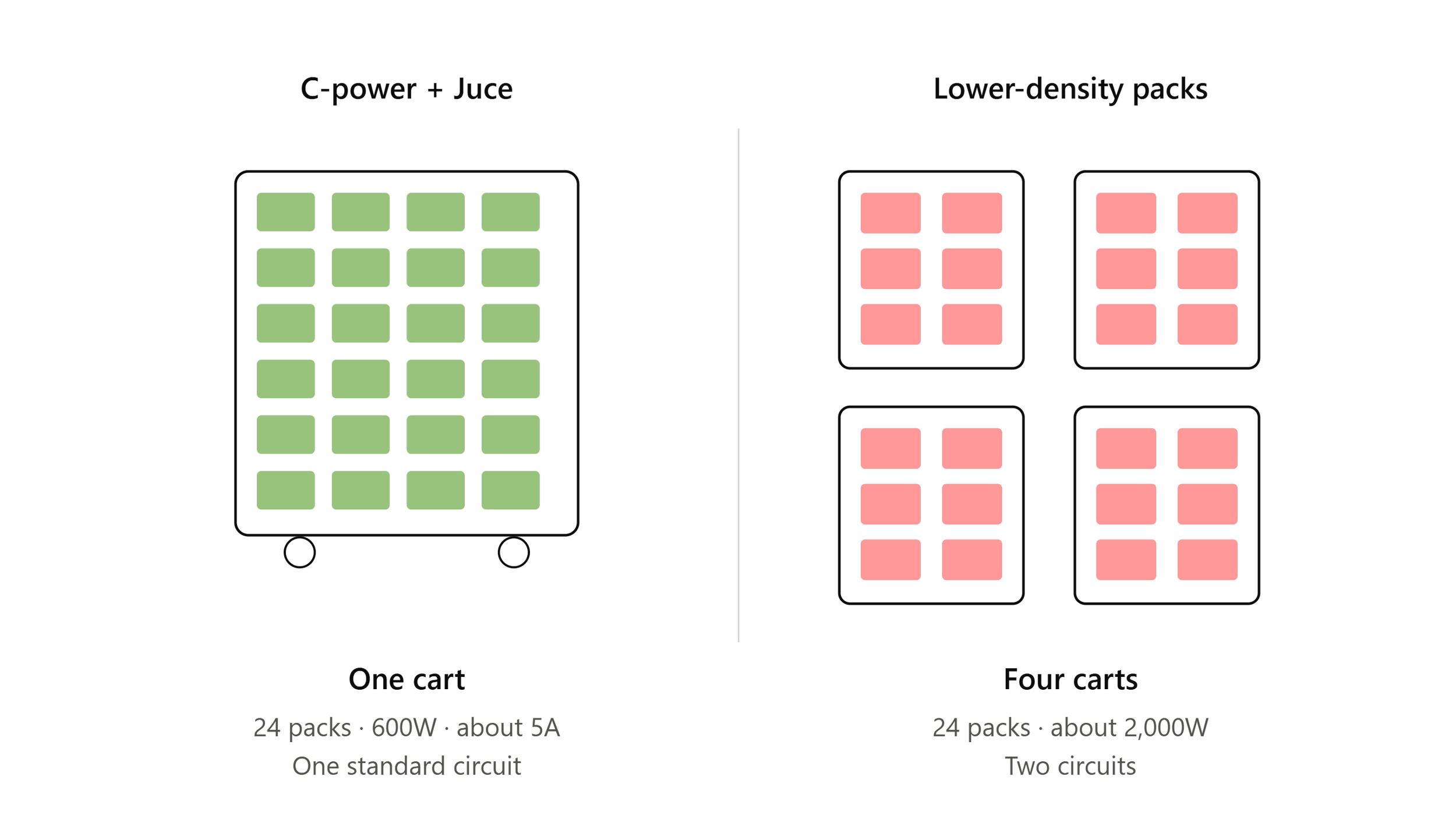
Charging the same 24-pack fleet. One Juce cart draws about 600W — roughly 5 amps on a single standard circuit. Based on a manufacturer's published charging specifications, systems built on lower-density packs typically require four six-bay carts and two circuits.
That 600W figure is also a consequence of the pack, not the cart. Energy density determines how much mass and volume a given capacity occupies, which in turn determines how many packs fit in a cart, which determines how many carts and circuits a floor needs. Systems built on lower-density chemistry carry the same energy in a larger, heavier pack, and the charging infrastructure grows
The difference shows up as floor space, receptacle count, and whether charging is something a building installs or something a facilities team plugs in.
Where the load actually is
Whatever happens to laptop efficiency, the display does not benefit. It draws continuously whenever someone is at the desk, and it has no battery of its own. Phones are trivial. The screen is the load that has not gotten easier.
A 24-inch monitor — still the volume seller in commercial work — draws roughly 15 to 25 watts in normal use. C-Power runs one longer than anyone sits in front of it.
C-Power delivers DC — up to 12 amps across four outputs, plus dual USB-C. Where a desk needs conventional AC receptacles, an inverter in the furniture provides them.
That division is deliberate. The inverter is the heaviest and hottest component in any portable power product, and it is also the most likely to fail. By leaving it in the furniture, the part a person lifts several times a week is just the cells and control electronics, and nothing else. That is a large part of why C-Power weighs 3.5 pounds.
It also means the desk can run more than what charges over USB-C: a monitor, a sit-stand lift motor, a wireless charger. As laptops reduce their need for the AC outlet, those are the loads that keep a workstation tethered.
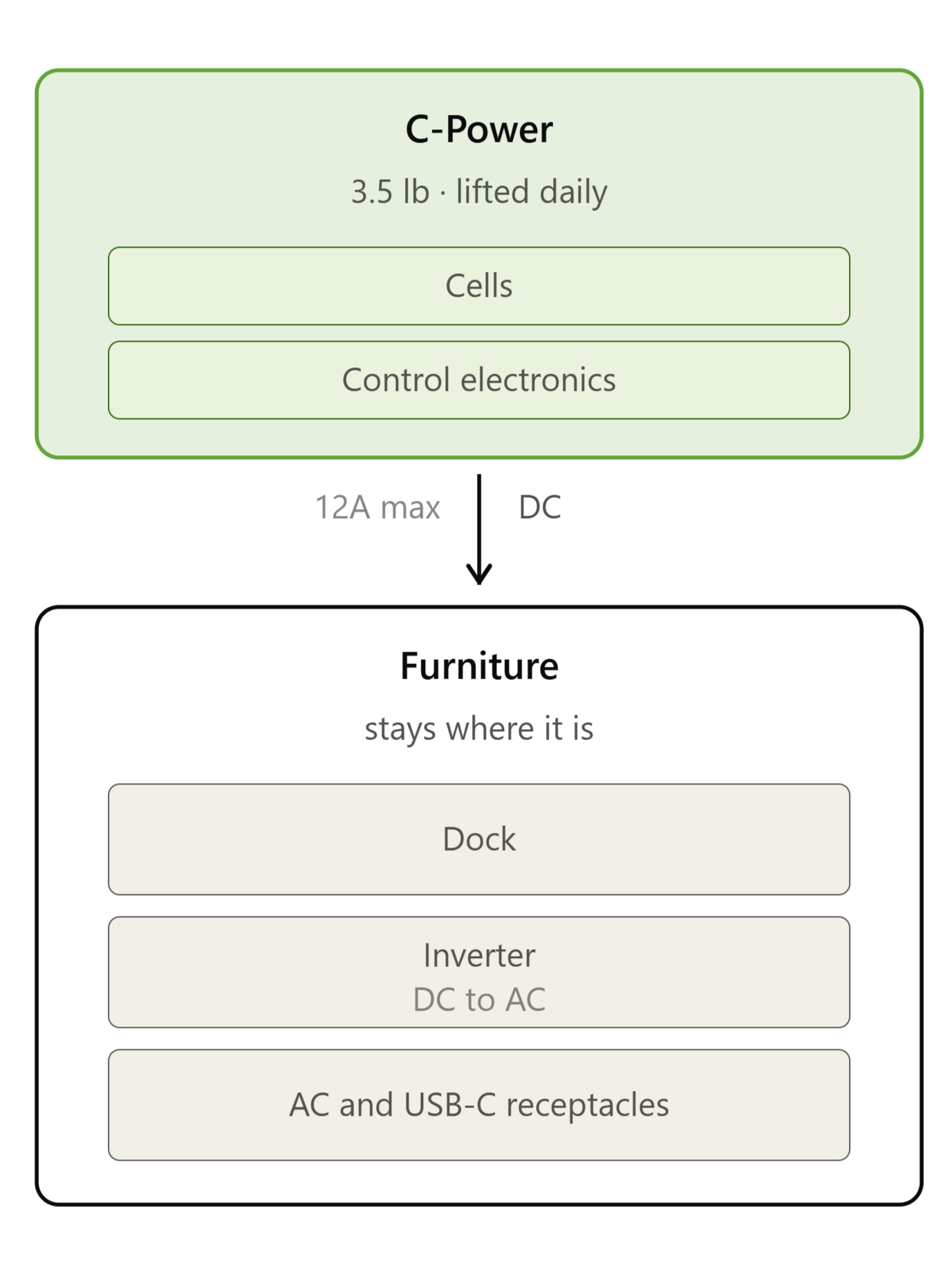
The inverter is the heaviest, hottest component in any portable power product. Leaving it in the furniture is why the part a person lifts weighs 3.5 pounds.
What to ask about any battery-powered workstation
The cells are proven. What varies between products is how they are applied — and in a market this new, published specifications vary more than they should. Four questions separate the products.
How long does the battery last, and measured to what?
Ask for a cycle count, and ask what capacity remains at the end of it. C-power is rated for 2,500 charge cycles with 70 percent of usable capacity remaining, across a seven-year service life. A cycle count without an attached retention threshold tells you nothing.
Does the battery power the furniture, or is something else required?
Ask what else must be purchased before the battery delivers anything. An adapter or power post mounted to the table is another component to buy, another part to lose, and it consumes floor space beside the work surface. C-Power docks into the worksurface. Nothing sits next to the desk.
What does it weigh?
Energy density is the practical difference between chemistries. The same stored energy in a lower-density cell means a heavier, larger pack — and someone lifts it several times a week. C-Power weighs 3.5 pounds.
How many packs can charge on one circuit?
A Juce system charges 24 packs at roughly 5 amps — one cart, one standard outlet. Ask for the figure, then ask how many carts and how many circuits a full deployment actually needs. That is where floor space and receptacle count are decided.
Where C-Power works
Respond! — Integral AC and DC power, fixed-height and sit-stand, 60 x 30 and 72 x 30. The dock is built into the work surface.
CampFire — Collaborative and training settings, 3- and 4-seat positions, AC and USB-C at the work surface, standard and ADA heights. In a classroom running Chromebooks at 5 to 10 watts per device, one C-Power covers an instructional day.
Tables already on the floor — Battery hook kits mount C-Power to existing tables with no modification.
Third-party and custom furniture — The desk power system is available on its own, with installation drawings, for furniture we did not build. The installing dealer owns the installation; component warranties are unchanged.
Handheld — At 3.5 pounds with a carry handle, C-Power moves to wherever it is needed inside the building. It is not travel equipment: at 240 Wh, it exceeds the 100 Wh passenger-aircraft threshold and ships as Class 9 dangerous goods.