The Infrastructure Tax: Why "Fixed" Offices Are Devaluing Your Portfolio
Utilizing Zero TI and Agile Power to Outpace the Home Office Productivity Multiplier
By Robert Kroon
The structural paradigm of the American white-collar workforce has undergone a foundational shift from centralized corporate hubs to a decentralized network of high-performance domestic nodes. As of early 2026, the transition toward hybrid and remote work has moved beyond a crisis-response phase into a stabilized, technologically mature reality.
This transition has highlighted a significant functionality inversion, where many white-collar workers have a more capable, personalized, and efficient office environment at home than in the traditional corporate setting. This analysis examines the quantitative and qualitative dimensions of this shift, focusing on screen real estate, computational performance, acoustic interruptions, and network throughput, while articulating the strategic necessity of the corporate tech stack in a fragmented labor market.
The Quantitative Landscape of Professional Workspace Distribution
To quantify the fraction of the workforce with a superior home office, one must first define the extent of remote participation. By the first quarter of 2024, approximately 35.5 million individuals in the United States—representing 22.9% of the total workforce—engaged in telework or worked from home for pay.1
Among "remote-capable" white-collar employees, the numbers are even more pronounced. In early 2026, Gallup longitudinal data indicated that 52% of remote-capable employees operate in a hybrid environment, while 26% are exclusively remote.3 This implies that nearly 78% of the professional workforce depends on a domestic workspace for a significant portion of their weekly output.
The "functionality gap" is best captured by the Leesman Index, a global benchmark for workplace experience. By 2024, the average work-from-home experience (H-Lmi) achieved a score of 79.5 out of 100, maintaining a persistent 10-point lead over the average office experience (Lmi), which stagnated at 69.5.4 This gap suggests that for roughly one-third of the white-collar workforce—specifically those in high-skill, tech-enabled roles—the home environment is not just more comfortable, but objectively more functional for the demands of modern knowledge work.6
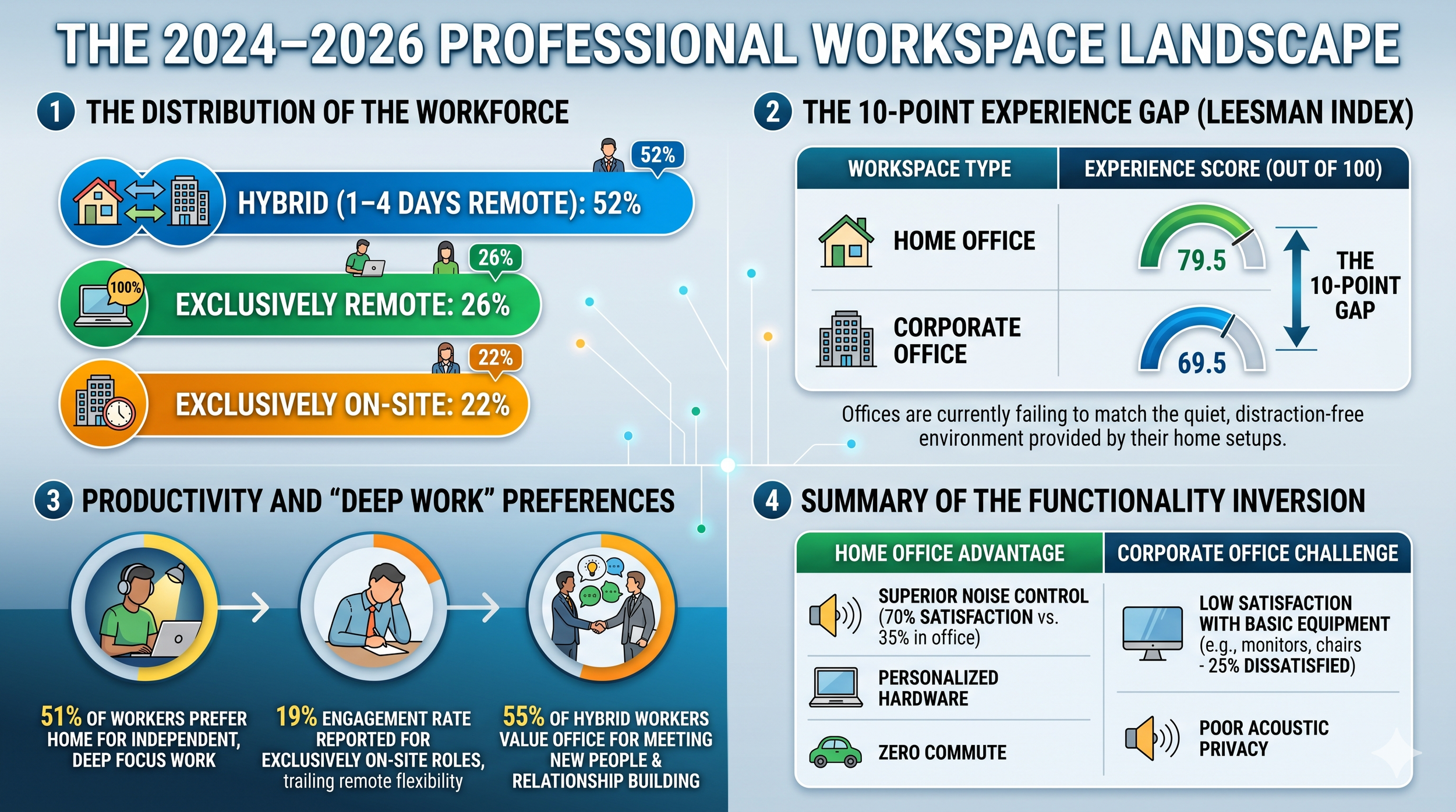
Workplace Participation and Experience Benchmarks (2024-2026)
The demographics of this shift show that senior-level roles lead the way in flexible work, with 30% in hybrid arrangements and 13% fully remote, compared to entry-level workers who are more likely to be on-site (18% hybrid, 9% remote).9 This seniority-based distribution is critical, as experienced professionals often possess the financial capital to invest in superior home hardware, further widening the functionality gap between their personal setups and standard corporate offerings.
Vector I: The Visual Workspace and Screen Real Estate
One of the most immediate indicators of home office superiority is the provision of screen real estate. Screen size and resolution are not merely matters of luxury; they are direct determinants of cognitive throughput. Research from the University of Utah and Jon Peddie Research indicates that the transition from a single monitor to a dual-monitor setup can increase productivity by 20% to 42%.10 This gain is achieved through the reduction of "context-switching costs"—the time and mental energy required to toggle between browser tabs, spreadsheets, and communication apps.
The Resolution and Multitasking Efficiency Gap
In the corporate environment, procurement cycles often favor standardized, low-cost 1080p monitors. In contrast, professionals who have customized their home offices frequently pivot toward high-definition (QHD or 4K) and ultrawide displays. A 27-inch QHD monitor provides significantly more "pixel real estate" than a standard laptop display, allowing a worker to keep a browser, a spreadsheet, and a messaging sidebar open simultaneously.12 The efficiency gain is quantifiable: analysts have found that switching to QHD allows for 30% more code or data to be visible on-screen without sacrificing legibility.12
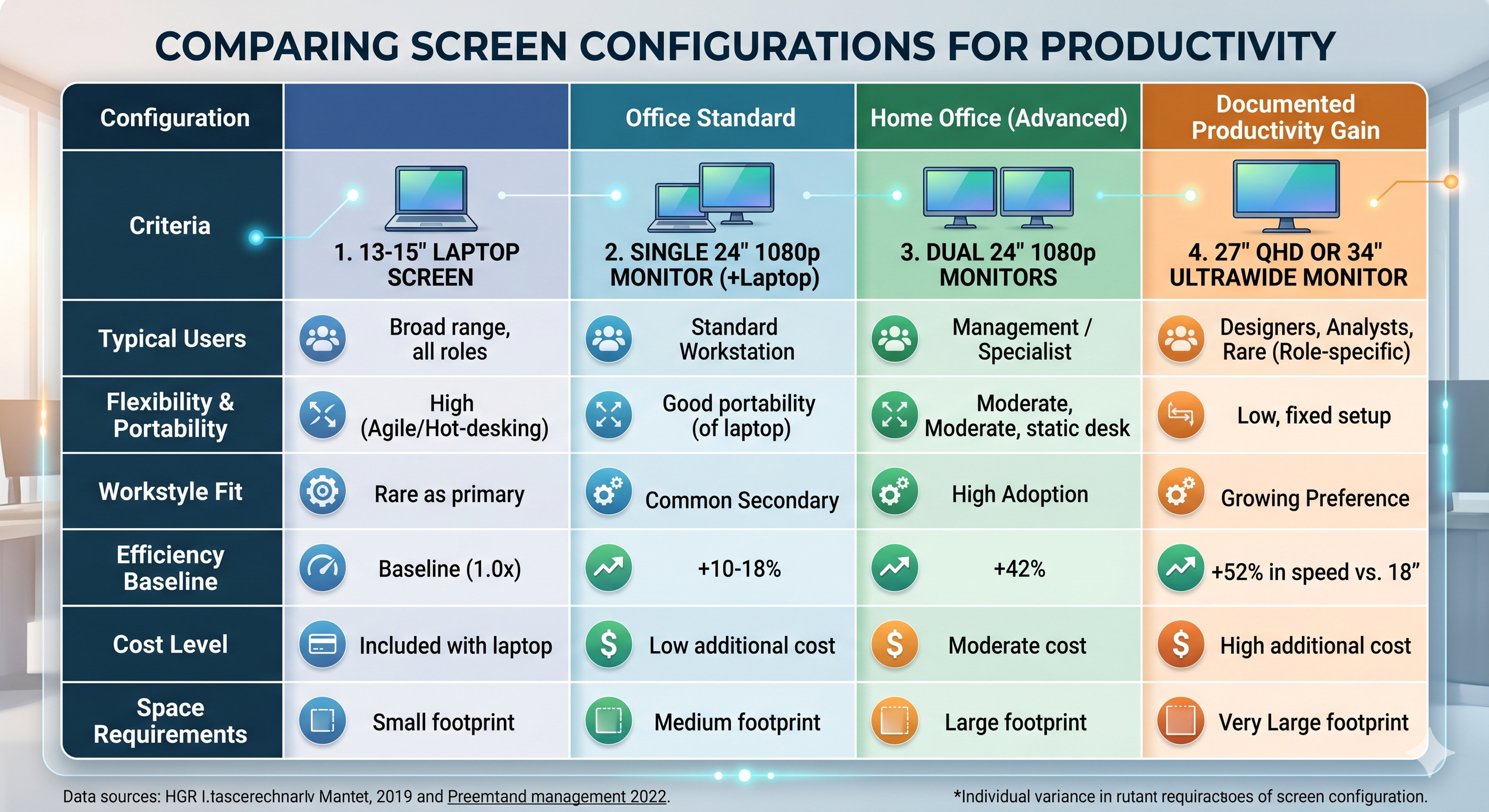
Comparative Impact of Display Technology on Productivity
The fraction of the workforce with "more screen space" at home is estimated to be significant, particularly as 76% of remote workers express high satisfaction with their home monitor setups, compared to 25% of on-site workers who are actively dissatisfied with their basic office equipment, including screens.5 Furthermore, the rise of "laptop screen extenders" in 2026 highlights a workforce that is no longer willing to accept the productivity drop associated with moving from a multi-monitor home setup to a single-screen office desk.14
Vector II: Computational Power and the Performance Ceiling
The second vector of functionality inversion concerns the "computer" itself. Corporate IT departments typically manage assets through a multi-year lifecycle, often resulting in employees being tethered to hardware that is three to five years old. This institutional inertia creates a "tech debt" problem. Approximately one in three IT professionals (33%) identifies tech debt as a "very serious" problem within their organization, and 48% report that their companies still utilize software that has reached its end of life (EOL).15
The Institutional Tech Debt vs. Personal Agility
In the home office, high-performing individuals often bypass corporate hardware limitations. While 57% of employers do not allow company equipment to be used at home, 31.8% of remote workers have simply purchased their own hardware to ensure they have the processing power required for their specific tasks.16 This is particularly evident in the tech sector, where 89% of employees can work remotely and frequently utilize personal workstations with higher RAM (16GB+), SSD storage, and current-generation processors that handle resource-intensive tasks—such as video conferencing while running large datasets—without the "lag" common in aging corporate laptops.17
Furthermore, the "flexibility gap" in technology is stark. While 83% of IT professionals value flexible work, there is a 58-point difference between the flexibility they desire and what their corporate systems actually provide.15 This digital disconnect is not just an IT issue; it is a retention risk. Over 53% of Millennials have considered quitting due to a lack of workplace flexibility, which is often tied to the inability of corporate hardware to support modern, autonomous work styles.15
Vector III: The Acoustic Frontier and the Interruption Cost
The most profound functional advantage of the home office for white-collar professionals is the control over the acoustic environment and the resulting reduction in interruptions. The average white-collar employee is productive for only 2 hours and 53 minutes per day, with the remainder of the 8-hour workday lost to distractions.19 In the corporate office, non-work-related discussions with colleagues consume an average of 40 minutes daily, while the open-plan design—favored by 70% of organizations for its perceived collaborative benefits—is often the primary source of cognitive disruption.5
The Cognitive Science of "Deep Work"
Focus-intensive, "deep work" typically occurs in 90-120 minute cycles.20 Every interruption, even a minor one, incurs a "resumption lag" that destroys flow and can cost up to 40% of a worker's productivity through the mental blocks created by task-switching.19 In corporate settings, satisfaction with noise control is abysmal at 35%, and only 40% of workers are satisfied with the availability of quiet work zones.5
Conversely, the home environment is increasingly viewed as the primary site for concentration. Workers feel 48.5% less distracted when working from home, citing the absence of ambient conversations in open workspaces as a major benefit.21 While the office remains superior for collaborative tasks (55% of workers prefer it for meeting new people), the home has become the functional standard for independent, desktop-focused work, which 89% of employees identify as their most critical need.5
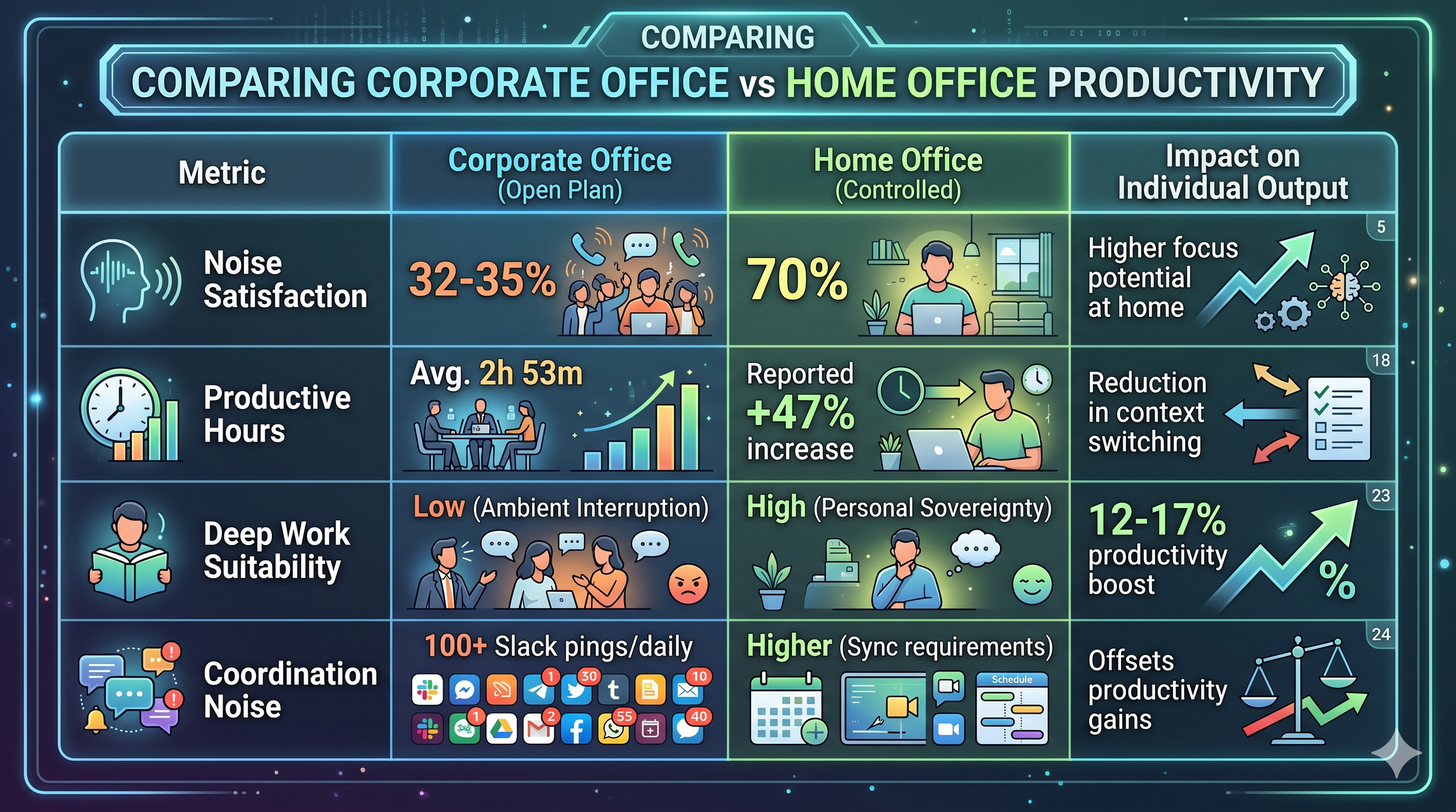
Comparative Analysis of Interruptions and Focus Productivity
The fraction of the white-collar workforce with "less interruption" at home is effectively identical to the fraction that is remote-capable and possesses a dedicated workspace (approximately 75-80% of those in tele-capable jobs).8 However, this gain is partially offset by the "Complexity Trap," where digital communication tools (Slack, Teams) have filled the vacuum of physical interruptions with a relentless stream of digital coordination overhead.24
Vector IV: Network Infrastructure and the Symmetrical Bandwidth Gap
The fourth vector of functionality is the speed and reliability of the internet connection. Historically, the corporate office was the only location where a professional could access high-speed "broadband." However, the deployment of residential fiber-optic networks and the shift in Federal Communications Commission (FCC) standards have inverted this dynamic for many. In 2024, the FCC quadrupled the download threshold for high-speed internet to 100 Mbps, a standard met or exceeded by 92% of US households.26
Residential Fiber vs. Corporate Shared Lines
While corporate networks often have higher total capacity, they are shared by hundreds or thousands of users and burdened by complex security protocols (VPNs, firewalls) that can introduce latency. In contrast, 49% of US residential areas now have access to fiber-optic connections, which offer "symmetrical" upload and download speeds.27 Symmetrical bandwidth is critical for the modern white-collar workflow, which relies heavily on cloud backups, large file transfers, and high-definition video conferencing.28
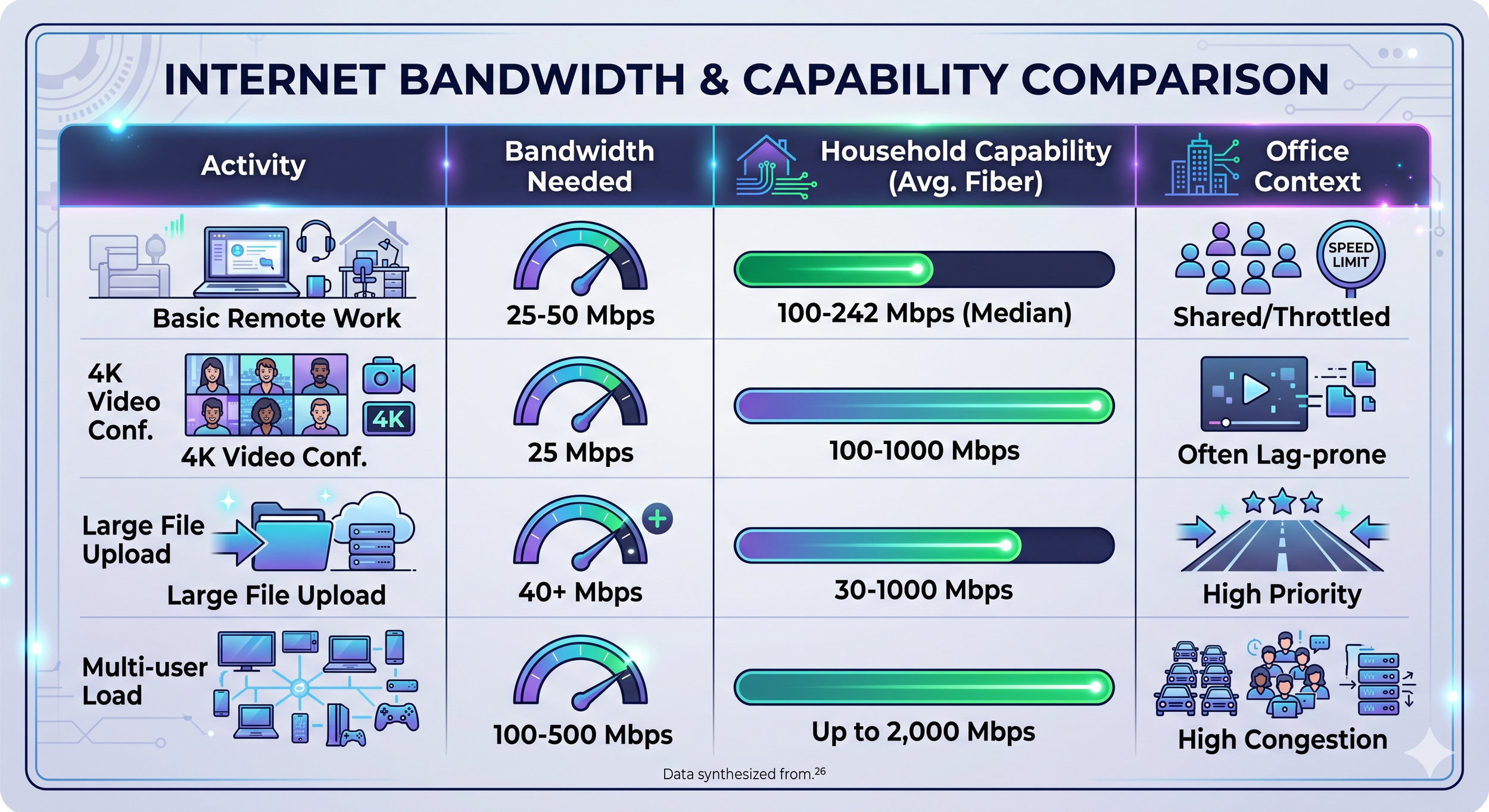
Internet Speed Requirements vs. Household Capability (2025)
For a professional household with multiple people working or learning remotely, the median US download speed of 242.38 Mbps in 2024 is more than sufficient.32 Approximately 88% of residents now express interest in Gigabit fiber, viewing it as a prerequisite for professional mobility.33 Consequently, the fraction of the workforce with "higher speed internet" at home includes almost all white-collar professionals living in urban or suburban fiber-enabled corridors—roughly 50-60% of the relevant workforce.27
The Strategic Importance of the Office Tech Stack
If the home office often wins on hardware and focus, why does the "tech stack" at the office remain critically important? The importance lies in the stack's role as the "organizational glue" that enables collaboration, ensures security, and mitigates the "digital disconnect" that threatens to erode corporate culture and efficiency.
1. Mitigation of the "Digital Disconnect"
A fragmented tech stack is a silent productivity killer. Research shows that employees lose more than 11 hours per week chasing information across disconnected platforms.34 When an organization's digital infrastructure is siloed—a problem reported by 55% of IT professionals—the resulting "gray work" forces employees to spend their time on administrative navigation rather than their core responsibilities.15 A unified, modern tech stack (incorporating AI, CRM, and centralized CMS intranets) is the only mechanism that can return this lost time to the workforce.35
2. The AI Inflection Point and Collective Intelligence
In 2025, generative AI became a "Swiss Army Knife" for the workplace, used by 43% of businesses for writing tasks and 37% for data analysis.37 The office tech stack is the conduit for these tools. Without a centralized, secure AI infrastructure, employees are 33% more productive in the hours they use AI, but the organization loses "collective intelligence" as data remains trapped in personal, unvetted accounts.37 A robust office stack ensures that AI-driven personalization can support employees in their "flow of work," rather than forcing them to work against a fragmented current.34
3. Security, Governance, and "Ergonomic Debt"
The decentralization of the workforce has created a "fragmented archipelago" of liability.23 The office tech stack now extends to the home network, requiring sophisticated Software-as-a-Service (SaaS) and IT Asset Management (ITAM) tools to govern security.39 Furthermore, organizations are accumulating "ergonomic debt"—a wave of musculoskeletal injury claims resulting from sub-optimal home setups.23 The office tech stack must include data-driven ergonomic assessments (often AI-powered) to identify high-risk groups and provide targeted interventions, potentially boosting productivity by up to 17.8% while reducing legal exposure.23
The Socio-Technical Outcome: The Parity Paradox
The fraction of the US white-collar workforce possessing a superior home office varies by the specific technical vector:
Screen Real Estate: Estimated 40-50% (High adoption of multi-monitor/ultrawide setups among specialists).10
Better Computer: Estimated 30-35% (Professionals bypassing corporate tech debt with personal hardware).15
Less Interruption: Estimated 75-80% (Those in remote-capable jobs with dedicated home spaces).3
Higher Speed Internet: Estimated 50-60% (Suburban/Urban fiber-enabled households).27
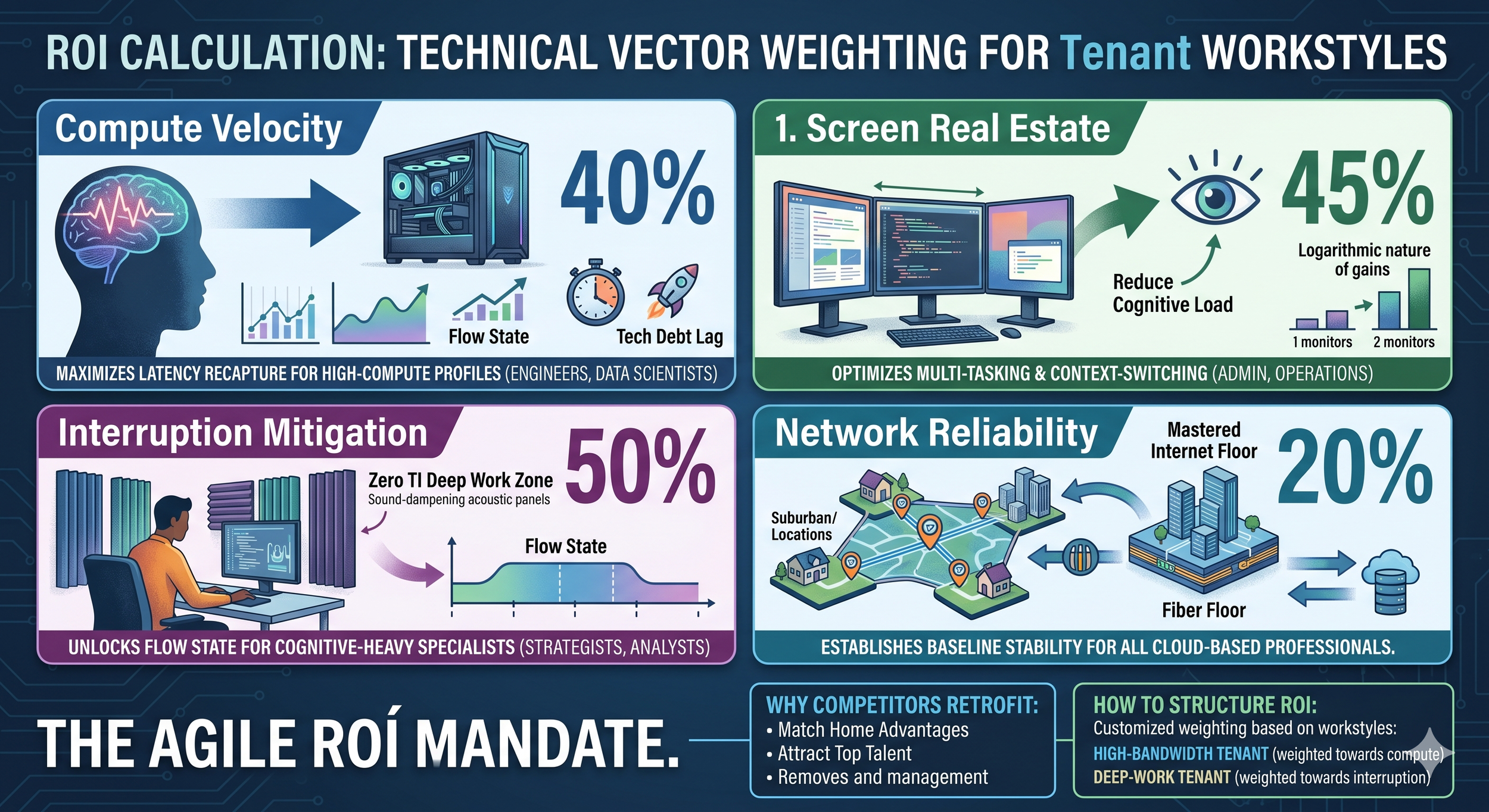
The mathematical relationship between these technical vectors and white-collar productivity ($P$) can be expressed as a multi-factor optimization model. While traditional office environments often suffer from "corporate tech debt," the home office allows for a tailored configuration where productivity is not just additive, but multiplicative based on the synergy of these four vectors.
The Productivity Synergy Model
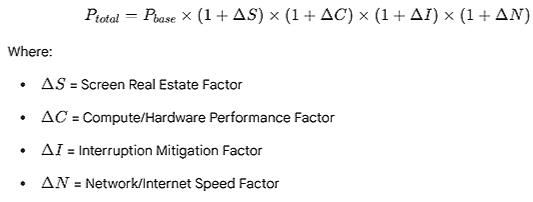
We can represent the total productivity gains as a function of the specific enhancements:
Technical Vector Breakdown
1. Screen Real Estate (S)
Increased screen real estate reduces the "cognitive load" of window switching. Mathematically, the efficiency gain follows a logarithmic growth curve—moving from one to two monitors provides a massive jump, while moving from three to four offers diminishing returns.

2. Compute Velocity (C)
The "Better Computer" vector addresses the latency between thought and execution. If a corporate laptop has a 2-second lag on 50 tasks per day, a superior home machine recaptures (t) seconds of "flow state" that would otherwise be lost to micro-frustrations.
3. Interruption Density (I)
This is the most significant multiplier. Productivity in deep-work tasks is inversely proportional to the frequency of interruptions (f):

With a 75-80% advantage in dedicated home spaces, the "dwell time" on complex problems increases exponentially compared to an open-office plan.
4. Network Reliability (N)
Fiber-enabled speeds (N) act as the floor for all collaborative tasks. High-speed upload/download reduces the friction of cloud-based synchronization and high-fidelity video conferencing, ensuring the "last mile" of data delivery never bottlenecks the professional's output.
The Financial Friction of "Fixed" Infrastructure
For asset managers and employers, these metrics expose a harsh reality: the traditional fixed office is no longer an asset—it’s a productivity tax. When a workforce possesses superior technical vectors at home, a static office environment acts as a drag on performance.
To maintain asset valuation and tenant retention, the physical workplace must pivot to an Agile infrastructure. This means matching or exceeding home-grown advantages through flexible power and reconfigurable layouts that facilitate both deep-work focus and high-bandwidth collaboration.
The Productivity Gap Equation
The financial impact of this infrastructure gap can be modeled by comparing the net output of a home-integrated professional versus one restricted by "office tech debt":
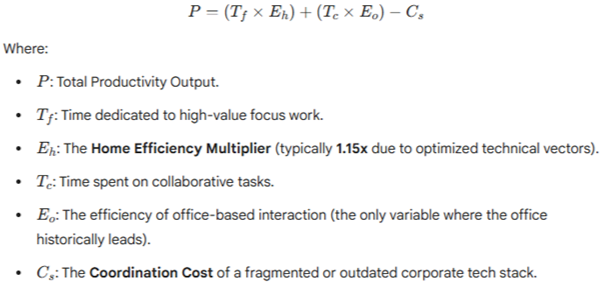
The financial impact of this infrastructure gap can be modeled by comparing the net output of a home-integrated professional versus one restricted by "office tech debt":
If the Home Efficiency Multiplier consistently outpaces the Office Efficiency Multiplier because of superior home hardware and fewer interruptions, the "Fixed" office becomes a liability. Implementing a Zero TI strategy is the only way to drive the Office Efficiency Multiplier high enough to justify the commute and the square footage.
Strategic Components of the 2026 Office Tech Stack
Conclusion: The New Mandate for Workplace Design
The research indicates that the "office" is no longer a physical location, but a digital capability. While the home office has won the war for individual focus and high-performance hardware, the corporate tech stack remains the only viable platform for the orchestration of collective effort. To remain competitive, organizations must pivot from providing "desks and chairs" to providing "integration and intelligence."
The fraction of the workforce with a superior home office is a signal to employers: if the office does not beat the home for focus, meetings, and equipment ("kit"), employees will continue to ration their on-site days.43
Bridging the 10-point Leesman Index gap requires a radical reinvestment in the fundamental tech stack—moving beyond legacy ERP systems toward unified, human-centric digital environments that allow professionals to slide between home and office without friction. In the phygital era, the most effective office is one that remains invisible to the worker, allowing for deep focus at home and effortless collaboration on-site through a single, superintelligent infrastructure.
Works cited
Telework trends : Beyond the Numbers - Bureau of Labor Statistics, accessed April 21, 2026, https://www.bls.gov/opub/btn/volume-14/telework-trends.htm
20+ Crucial Hybrid Work Statistics in the U.S. (2024-2025), accessed April 21, 2026, https://high5test.com/hybrid-working-statistics/
Global Indicator: Hybrid Work - Gallup, accessed April 21, 2026, https://www.gallup.com/401384/indicator-hybrid-work.aspx
The Complete Guide to Workplace Experience: Why It's the New Competitive Advantage in 2025 - Commonwealth Joe Coffee Roasters, accessed April 21, 2026, https://commonwealthjoe.com/blogs/blog/workplace-experience
2025 Office Agenda: How the Employee Experience Shaping Up, accessed April 21, 2026, https://www.diemuk.com/2025-office-agenda-how-is-the-employee-experience-shaping-up/
The Evolution of Working from Home - WFH Research, accessed April 21, 2026, https://wfhresearch.com/wp-content/uploads/2023/07/SIEPR1.pdf
Navigating the Workplace Revolution: - TwentyTwo, accessed April 21, 2026, https://twentytwo.co.nz/wp-content/uploads/2025/09/Navigating-the-Workplace-Revolution_TwentyTwo_2025.pdf
30+ Remote Work Statistics in the U.S. & Globally (2025–2026), accessed April 21, 2026, https://high5test.com/remote-work-statistics/
Remote work statistics and trends for 2026 - Robert Half, accessed April 21, 2026, https://www.roberthalf.com/us/en/insights/research/remote-work-statistics-and-trends
Size Matters: Why Screen Resolution is Crucial for Productivity - Issuu, accessed April 21, 2026, https://issuu.com/globalbusinessmedia.org/docs/ceo_reports_21___improving_the_hybrid_work_environ/s/12239481
Productivity Impact of Multiple Monitors - Plugable Technologies, accessed April 21, 2026, https://plugable.com/blogs/news/productivity-impact-of-multiple-monitors
FHD vs. QHD: The Ultimate Guide to Choosing the Best Resolution for Your Needs, accessed April 21, 2026, https://www.mobilepixels.us/blogs/blog/fhd-vs-qhd
State of Hybrid Work 2024 | US Report - Owl Labs, accessed April 21, 2026, https://owllabs.com/state-of-hybrid-work/2024
Best Laptop Screen Extender for Productivity in 2026 | INVZI, accessed April 21, 2026, https://invzi.com/blogs/news/best-laptop-screen-extender-for-productivity-2026
2025 Technology at Work Report | Ivanti, accessed April 21, 2026, https://www.ivanti.com/resources/research-reports/tech-at-work
Statistics That Need To Be Known About Home Office Ergonomics - LoctekMotion, accessed April 21, 2026, https://www.loctekmotion.com/blogs/Ergonomic%20Design/Statistics%20That%20Need%20To%20Be%20Known%20About%20Home%20Office%20Ergonomics
What Makes a Home Office Set Worth the Investment? - R&R Furniture Gallery, accessed April 21, 2026, https://rrfurnituregallery.com/blogs/news/what-makes-a-home-office-set-worth-the-investment
Remote Work Statistics: Latest Trends and Insights for 2024 - Zoe Talent Solutions, accessed April 21, 2026, https://zoetalentsolutions.com/remote-work-statistics/
Employee productivity statistics you need to know - Oak Engage, accessed April 21, 2026, https://www.oak.com/2022/04/27/employee-productivity-statistics-you-need-to-know/
Outcome-Based Management: Why Goals Beat Office Hours - Andrés Max, accessed April 21, 2026, https://andresmax.com/outcome-based-management-why-goals-beat-office-hours/
Practices Around Working from Home and Early Indicators on Returning to Work after the COVID-19 Pandemic: Survey from Microsoft, accessed April 21, 2026, https://www.microsoft.com/en-us/research/wp-content/uploads/2020/07/NFW-Wang-et-al-5f1e2aaa7889e.pdf
What 2025 Taught Us About the Modern Workplace: Acoustics ..., accessed April 21, 2026, https://www.softdb.com/blog/acoustics-design-productivity/
Remote Ergonomics: Liability and Safety Training for the Home Office - TechClass, accessed April 21, 2026, https://www.techclass.com/resources/learning-and-development-articles/remote-ergonomics-liability-and-safety-training-for-the-home-office
If worker productivity has tripled since the 1970s because of technology, why is the "40-hour work week" still the standard instead of us all just working 15-20 hours? : r/NoStupidQuestions - Reddit, accessed April 21, 2026, https://www.reddit.com/r/NoStupidQuestions/comments/1pthjej/if_worker_productivity_has_tripled_since_the/
2025 Remote Work Conference | Hoover Institution, accessed April 21, 2026, https://www.hoover.org/events/2025-remote-work-conference
What internet speed do you really need? - Technical.ly, accessed April 21, 2026, https://technical.ly/software-development/what-internet-speed-do-you-really-need/
Internet Facts and Statistics 2025 | HighSpeedInternet.com, accessed April 21, 2026, https://www.highspeedinternet.com/resources/internet-facts-statistics
Business vs. Residential Internet: Which Should You Choose? | HighSpeedInternet.com, accessed April 21, 2026, https://www.highspeedinternet.com/resources/business-vs-residential-internet
Minimum Internet Speed for WFH: How Much You Need - NOVOS FiBER, accessed April 21, 2026, https://novosfiber.com/blog/minimum-internet-speed-wfh
What Internet Speed Do I Need To Work From Home? - Astound, accessed April 21, 2026, https://www.astound.com/learn/internet/internet-speed-working-from-home/
What's the Ideal Internet Speed for Remote Work? - UbiFi, accessed April 21, 2026, https://ubifi.net/blog/internet-speed-for-remote-work/
Internet Speeds: USA vs. The Rest of the World, accessed April 21, 2026, https://tachus.com/internet-speeds-usa-vs-the-rest-of-the-world/
DESIGN NINE - Revize, accessed April 21, 2026, https://cms7files.revize.com/carrollcova/document_center/Broadband%20Project/CarrollCounty_Broadband_Study_2022.pdf
How a Fragmented Tech Stack Is Hurting Your Workforce | Workday ..., accessed April 21, 2026, https://www.workday.com/en-us/perspectives/hr/the-digital-disconnect.html
What is a CMS Intranet? Content Management System - Simpplr, accessed April 21, 2026, https://www.simpplr.com/glossary/cms-intranet/
Zoho CRM Implementation Partner: Your Complete 2025 Guide, accessed April 21, 2026, https://pyramidbits.tech/zoho-crm-implementation-partner-guide-2025/
THE IMPACT OF TECH ON THE WORK PLACE., accessed April 21, 2026, https://images.tech.co/wp-content/uploads/Techco-Workplace-Report-2025.pdf
The Impact of Generative AI on Work Productivity | St. Louis Fed, accessed April 21, 2026, https://www.stlouisfed.org/on-the-economy/2025/feb/impact-generative-ai-work-productivity
SaaS Management vs SAM vs ITAM: What's the Difference? (2026) | Torii, accessed April 21, 2026, https://www.toriihq.com/articles/saas-vs-sam-itam
6 Top Middleware Integration Tools: 2026 Expert Review - Skyvia, accessed April 21, 2026, https://skyvia.com/blog/best-middleware-integration-tools/
Top low-code Development Platforms Guide - Lark, accessed April 21, 2026, https://www.larksuite.com/en_us/blog/low-code-development-platforms
Remote Work 2.0: The Tech Setup Professionals Need in 2026 - Laptop Outlet, accessed April 21, 2026, https://www.laptopoutlet.co.uk/blog/remote-work-tech-setup.html
8 Game-Changing Stats on Office Design and Employee Engagement - AIHP, accessed April 21, 2026, https://aihp.in/8-game-changing-stats-on-office-design-and-employee-engagement/