
The 2026 Workplace Ecosystem: Infrastructure, Intelligence, and Strategic Adaptation
By Robert Kroon
Executive Summary
Anticipating events in the future is never easy, but necessary to build context around your plans and budgets.
As the global economy approaches the fiscal and calendar year of 2026, the built environment is entering a period of profound structural recalibration. The experimental phases of the post-pandemic era—characterized by tentative hybrid policies and temporary spatial pilots—are solidifying into a new, rigorous set of operating standards. The 2026 workplace is no longer defined merely by occupancy rates or aesthetic modernization; it is defined by infrastructure resilience, regulatory compliance, and the physical integration of artificial intelligence.
This comprehensive report provides an exhaustive analysis of the trends influencing workplace design, construction, and management for 2026. Based on extensive industry data, the analysis indicates that 2026 will be characterized by a "bifurcated" market where premium, amenity-rich assets in suburban hubs and prime urban districts thrive, while outdated stock faces obsolescence or forced conversion.1 The pace of retrofitting is accelerating, driven not merely by tenant preference but by the convergence of punitive climate regulations (such as New York’s Local Law 97 and the SEC’s climate disclosure rules) and the technical exigencies of hosting on-premise AI infrastructure.3
Furthermore, the integration of AI is transitioning from software applications to hardware realities, influencing architectural acoustics, server room cooling requirements, and electrical load capacities.5 Simultaneously, the electrical contracting industry faces a paradox of expanding backlogs in mission-critical sectors (data centers) versus a severe labor shortage, complicated further by new National Electrical Code (NEC) 2026 mandates regarding fault-managed power and electric vehicle (EV) infrastructure.7
The following analysis details the regulatory, economic, and technological vectors shaping the 2026 workplace, offering a roadmap for stakeholders navigating this complex ecosystem.
1. The Macro-Strategic Landscape of the 2026 Office Market
1.1 The Bifurcation of Value: Distress vs. Premium
The defining economic narrative for the 2026 office market is the widening chasm between Class A/Trophy assets and the remainder of the commercial stock. The market is not experiencing a uniform downturn; rather, it is functioning as two distinct, almost unrelated economies.
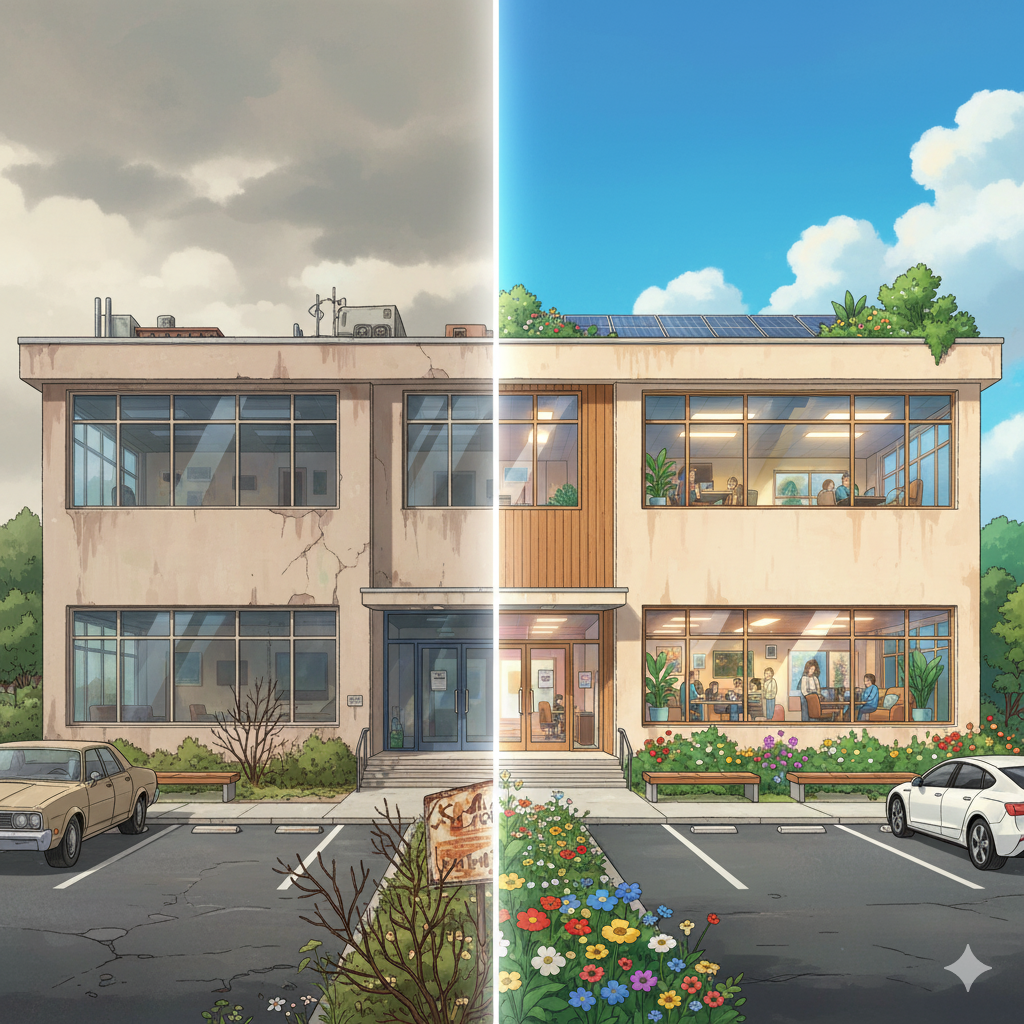
Research suggests that while the national office vacancy rate is projected to stabilize—forecasts range from a cautiously optimistic 15.9% by CoStar to a distress-signaling 24% by Moody’s, depending on the inclusion of sublease inventory and asset class—the aggregate number obscures the underlying disparity.1 High-quality, amenity-rich offices in prime markets continue to attract tenants willing to pay premium rents to incentivize in-person attendance. Conversely, outdated buildings in secondary locations are experiencing "obsolescence," where the cost of retrofitting exceeds the asset's potential value.2
Craig Plescia, CEO of Plescia Construction & Development, notes that the market is "bifurcated," with outdated buildings in secondary locations struggling while high-quality assets thrive.2 This divergence is exacerbated by the shrinking construction pipeline. New office construction is expected to reach a 25-year low in 2026.1 This contraction in new supply acts as a stabilizing force for vacancy rates among existing Class A buildings. With fewer new builds entering the market, demand for high-quality space will likely compress vacancy in the top-tier segment, granting landlords of premium assets increased pricing power even as the broader market struggles.10
1.2 Investment Climate and Capital Markets
The investment climate for 2026 remains complex but is showing signs of a "resilient recovery".11 After years of stagnation, capital is beginning to flow more forcefully into the property sector, aided by a stabilization of interest rates. The Federal Reserve's monetary policy, specifically potential interest rate cuts heading into 2026, acts as a tailwind, lowering borrowing costs and opening the door for acquisitions and retrofits that were previously financially unviable.2
However, the investor’s profile has shifted. Private investors, who historically comprised about 30% of buyers, are projected to make up nearly 50% of acquisitions in 2026, while owner-users have increased their share from 5-8% to roughly 13%.1 This shift suggests a market driven less by institutional speculation and more by opportunistic, pragmatic capital deployment focused on long-term hold strategies and value-add renovations.
1.3 The "Soft Retirement" and Career-Stage Design
Sociological shifts are fundamentally influencing the strategic allocation of square footage. A notable trend for 2026 is the concept of "soft retirement" spaces. As workforce demographics shift, workplaces are being designed to support senior employees who wish to scale back their hours rather than exit the workforce entirely.12 This trend necessitates acoustic and ergonomic considerations that differ markedly from the high-energy collaborative zones designed for early-career professionals.
This aligns with a broader move away from generational stereotypes toward career-stage design. Early-career talent, who often lack adequate home office environments, prioritize professional development, mentorship, and coaching spaces. Mid-career professionals value efficiency and teamwork, while late-career leaders prioritize socialization and mentorship.13 Consequently, the 2026 workplace is moving away from the "musical chairs" of unassigned hot-desking toward "purposeful abundance"—a design philosophy that ensures a sufficient variety of spaces (quiet corners, vibrant hubs, mentorship zones) so employees have genuine agency rather than scarcity-driven anxiety.13
2. The Retrofit Revolution: Location and Velocity
2.1 The Accelerating Pace of Retrofitting
Will the pace of retrofitting buildings increase? The evidence points to a definitive yes. This acceleration is driven by three converging pressures that have moved from theoretical risks to operational realities in 2026:
Regulatory Compliance: Building performance standards (BPS) in major municipalities (NYC, Boston, Seattle) have compliance milestones in or near 2026, forcing owners to retrofit mechanical systems or face punitive fines.14
Tenant Demand and ESG: Corporate tenants, now subject to SEC Scope 1 and 2 emission disclosure requirements (effective for large filers in 2026 for FY2025 data), are prioritizing energy-efficient buildings to improve their own sustainability reporting. A "brown" building is increasingly seen as a liability on a tenant's balance sheet.3
Adaptive Reuse: The conversion of "zombie" office buildings to residential or mixed-use purposes is accelerating as a mechanism to correct the oversupply of uncompetitive office stock.2
2.2 Geographic Dynamics: Suburban Resurgence vs. Urban Core
While media attention often focuses on downtown revitalization, the data indicate a robust retrofit activity toward suburban markets. The question of where the most activity will occur—city centers or suburbs—has a nuanced answer: renovation is dominating the suburbs, while conversion is dominating the distressed urban core.
The Suburban "Flight to Quality"
Suburban offices are experiencing a renaissance, particularly those transforming into mixed-use ecosystems. The "commute-worthy" workplace in 2026 is often located closer to where employees live, reducing friction. In markets like Kansas City, Central New Jersey, and Atlanta, suburban office vacancies have dropped significantly in renovated assets, outperforming their Central Business District (CBD) counterparts.17
For example, renovations that upgrade older suburban properties to Class A standards—adding amenities like fitness centers, diverse food options, and improved connectivity—are yielding drastic vacancy reductions. In Kansas City, a strategic renovation reduced vacancy in one key asset from 28.5% in 2019 to 0.5% in 2024, a trend expected to generalize across suburban markets in 2026.17 The suburban model for 2026 is the "mini-downtown," integrating residential, retail, and green space into office parks to create 24/7 vitality.18
Urban Centers and Adaptive Reuse
In urban centers, the retrofit activity is heavily skewed toward adaptive reuse—specifically office-to-residential conversions. Cities with high office distress combined with acute housing shortages are the primary hotspots for this activity. San Francisco, Seattle, and Denver are identified as top markets where the economics of conversion are becoming most viable due to the disparity between high housing demand and low office utilization.16
However, the "flight to quality" remains relevant in cities. Manhattan and Miami, which have maintained lower vacancy rates compared to the national average, continue to see high-value retrofits of existing office stock to maintain their trophy status.19 The urban retrofit market is thus polarized: prime buildings are being polished to retain tenants, while Class B/C buildings are being gutted for residential conversion.
2.3 Statistical Outlook on Office-to-Residential Conversion
The pipeline for office-to-residential conversion has grown nearly 28% year-over-year leading into the 2026 cycle.20 While physical challenges remain (deep floor plates, window access, plumbing), the removal of underperforming stock is essential for market equilibrium. Estimates suggest that 2026 will see the maturation of projects initiated during the peak vacancy fears of 2023-2024.
Boston, specifically, shows significant potential. The "Conversion Feasibility Index" identifies Boston as having a high volume of convertible square footage—nearly 11.5 million square feet of office space classified as "Tier 1" for potential reuse.20 This indicates that while the need is highest in San Francisco, the feasibility and activity might be higher in markets like Boston where the building stock is more amenable to physical transformation.
3. Designing for the AI-Enabled Workforce
3.1 AI as Teammate: The "Agentic" Shift
Will designing for AI become a part of the thinking for workplace design? Absolutely. By 2026, Artificial Intelligence in the workplace will have evolved from a software tool to a perceived "teammate" or "agent." This shift, often termed "Agentic AI," involves intelligent systems that can map employee strengths, form agile teams, and execute complex workflows autonomously.12
Design implications for 2026 include the creation of environments that support "human-AI hybrid teams".21 This goes beyond screen placement; it involves designing spaces where voice-interaction with AI agents is normalized. The workplace must accommodate the "hum of an AI teammate," suggesting a need for acoustic zones that dampen voice commands to prevent them from becoming distractions.13
Gensler’s 2026 forecast emphasizes that "AI might join the team, but the vibe is still 100% human," suggesting that design must balance high-tech capability with high-touch human comfort.13 This means creating "immersive collaboration" spaces where digital agents are represented visually on screens or practically through voice interfaces, necessitating a rethinking of the traditional conference room.12
3.2 Acoustic Engineering for Voice-First Interfaces
As voice becomes a primary modality for interacting with AI agents (e.g., dictating to generative tools, conversing with scheduling agents), the acoustic privacy of the open plan is being challenged. Architects are leveraging AI-driven modeling to optimize sound absorption materials. The trend for 2026 includes the deployment of advanced polyester acoustic panels and soundscaping technologies that mask speech frequencies without creating oppressive silence.23
The goal is to improve "speech intelligibility" for the user while maintaining "speech privacy" for the neighbors—a critical balance when 50% of the floor might be speaking to an agent simultaneously. Soundscaping systems that use real-time natural sounds to mask voice frequencies are becoming standard infrastructure rather than optional add-ons.25
3.3 Workforce Mandates: AI Proficiency
Will more employers mandate that their workers be proficient in using AI tools? Yes. Digital literacy is no longer sufficient; "AI literacy" is becoming non-negotiable. Reports indicate that by 2026, 52% of talent leaders plan to add AI agents to their teams, effectively treating them as workforce entities.22 Consequently, employers are embedding AI training into onboarding and mandating continuous learning to prevent skill obsolescence.26
This mandate extends to the physical design of training spaces. The "corporate classroom" is returning but re-imagined as an immersive tech-enablement hub where workers learn to collaborate with their digital counterparts. These spaces require flexible furniture, high-bandwidth connectivity, and "purposeful abundance" of power and data ports to support training on power-hungry AI workstations.26
4. The Physical Infrastructure of AI: From Cloud to Edge
4.1 The Return to On-Premise: Edge AI
A critical, often overlooked trend for 2026 is the partial repatriation of data from the cloud to the "edge" (on-premise). Driven by latency requirements for real-time AI processing and, crucially, data privacy concerns regarding proprietary models, organizations are building local "Edge AI" server rooms within their office footprints.5
This reverses a decade-long trend of eliminating server closets. However, these are not the server closets of the early 2000s. The power density of AI-ready hardware (such as NVIDIA DGX systems) requires vastly different infrastructure. A single AI server can draw 10kW, and rack densities are approaching 60kW to 100kW per rack, compared to the traditional 5-10kW.27
4.2 Cooling: The Liquid Transition
The heat generation of on-premise AI hardware exceeds the capacity of traditional CRAC (Computer Room Air Conditioning) units. Consequently, 2026 will see a surge in retrofitting offices with liquid cooling infrastructure.
Technological Shifts and Building Impacts:
Direct-to-Chip Liquid Cooling: This involves cold plates attached directly to GPUs/CPUs, circulating coolant to a heat exchanger. This is becoming the standard for high-density racks (up to 120kW).28
Immersion Cooling: This involves submerging servers in dielectric fluid. While more efficient, this requires significant structural reinforcement due to the weight of fluid-filled tanks.6
Retrofit Requirements: Office retrofits must now account for plumbing loops to server rooms, reinforced floors for heavy immersion tanks, and heat rejection units on roofs that may already be crowded with PV panels and HVAC equipment. The market for liquid cooling components is projected to grow at a CAGR of 13% starting in 2026.30
4.3 Physical Security for AI Assets
With high-value AI hardware and proprietary models residing on-site, physical security standards for server rooms are tightening. "Zero trust" principles are being applied to physical access. 2026 standards include multi-factor authentication for server room entry (biometrics + pin + card), anti-tailgating mantraps, and video surveillance with retention policies compliant with new insurance mandates.31
5. Energy, Power, and the Grid at the Edge
5.1 Grid Instability and the "Four-Hour Wall"
Will concerns about power bring more attention to generation and battery storage at the edge of the grid? Yes. The proliferation of AI data centers, EVs, and building electrification is straining the grid. By 2026, the demand for electricity from data centers alone is expected to double from 2022 levels, consuming over 90 TWh annually.33
This creates a volatility risk for commercial buildings. In response, designers are focusing on "behind-the-meter" generation and storage. The "Four-Hour Wall"—the typical duration limit of lithium-ion battery discharge—is a major hurdle. For 2026, the trend is toward Long-Duration Energy Storage (LDES) capable of bridging gaps of 10 to 100+ hours, although Li-ion remains the dominant technology for short-term peak shaving.34
5.2 Batteries and Microgrids
Commercial buildings are increasingly being designed as microgrids. The integration of battery storage is no longer just for emergency backup but for economic arbitrage—storing solar energy during the day to discharge during peak pricing windows (4 PM – 9 PM).
Hybrid Systems: The pairing of solar-plus-storage is becoming standard, driven by policy reforms and the need to capture "clipped" energy (excess solar production that would otherwise be lost).35
VPP Participation: Buildings are entering Virtual Power Plant (VPP) programs, where their battery assets can be aggregated by utilities to stabilize the grid, turning the building into a revenue-generating asset.36
5.3 Electrification of Heat
Regulatory pressure is forcing the removal of on-site fossil fuel combustion. In regions like California, Washington, and Massachusetts, code updates effective in or near 2026 mandate electric heat pumps for space and water heating in new construction and major retrofits.37 This increases the building's electrical load significantly, necessitating larger service entrances and transformers—a critical consideration for the "pace of retrofitting" as electrical service upgrades often face long utility lead times.
Industrial electrification is also a key trend for 2026. The use of industrial heat pumps (IHP) to capture and reuse waste heat in manufacturing processes is expected to rise, reducing energy intensity by up to 90% compared to traditional boilers.39
6. Regulatory Headwinds and Industry Standards
6.1 The National Electrical Code (NEC) 2026
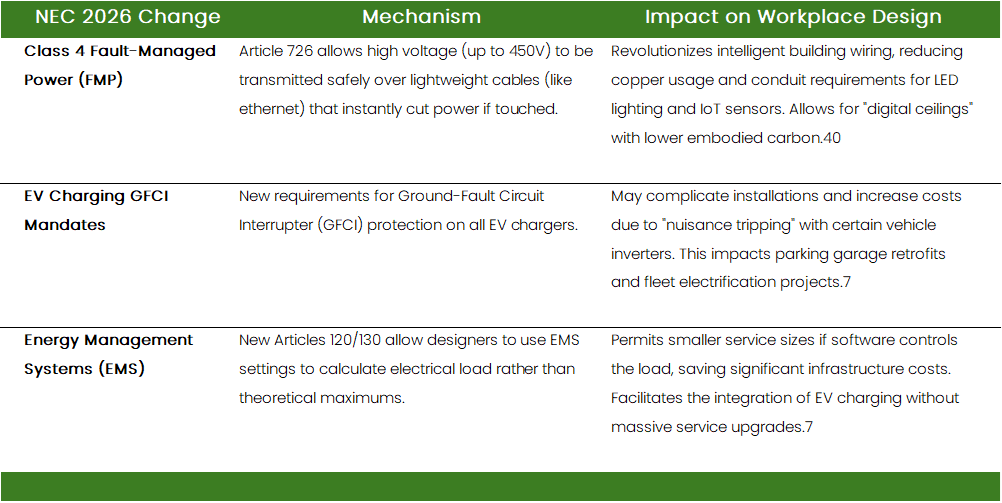
The proposed 2026 National Electrical Code (NEC) introduces transformative changes for commercial buildings, particularly regarding safety and load management. These changes will have immediate impacts on design and construction budgets.
6.2 Building Performance Standards (BPS) and Climate Reporting
SEC Climate Disclosure Rule: Large accelerated filers must disclose Scope 1 and Scope 2 emissions for FY2025 in their 2026 filings. This moves carbon reporting from "voluntary ESG" to "regulatory compliance." Corporate tenants will demand energy data transparency from landlords, and buildings that cannot provide granular data or demonstrate efficiency will lose competitiveness.3
NYC Local Law 97: Strict emissions limits are in effect. By 2026, the "good faith" extensions will be scrutinized, and owners face fines of $268 per ton of carbon over the limit. This is the primary driver for window replacements, insulation upgrades, and boiler electrifications in New York. The 2026 compliance year puts immense pressure on owners to finalize retrofits started in 2024-25.4
ASHRAE 241 (Control of Infectious Aerosols): Following the pandemic, this standard provides a code-enforceable framework for air cleaning. While not yet universally mandated, it is becoming a "standard of care" for Class A office design to mitigate liability and ensure business continuity during flu/virus seasons. It defines "equivalent clean airflow" targets that often require upgraded filtration or UV-C systems.44
6.3 State-Specific Energy Codes
California (Title 24): The 2025 Building Standards Code becomes effective January 1, 2026. It emphasizes embodied carbon reduction (concrete/steel limits), wildfire resilience (air filtration), and further electrification of appliances.37
Massachusetts (Stretch Code): The "Specialized Stretch Code" requires net-zero readiness. By 2026, many municipalities will enforce all-electric requirements for new construction, effectively banning gas hookups in new commercial builds.47
Washington (Clean Buildings Performance Standard): The compliance window for Tier 1 buildings opens fully. By 2026, commercial buildings over 50,000 sq. ft. must meet energy intensity targets or face penalties, driving a wave of energy efficiency retrofits in the Pacific Northwest.49
6.4 The "Matter" Standard
By 2026, the "Matter" interoperability standard for smart building devices is expected to achieve widespread adoption in the commercial sector. This eliminates the "walled garden" problem where sensors and controls from different vendors cannot communicate. For workplace design, this enables a unified "digital twin" of the office, allowing for predictive maintenance and seamless user experiences (e.g., temperature adjusting automatically based on meeting room occupancy).50
7. The Construction Economy: Labor, Materials, and Tariffs
7.1 The Electrician Shortage and Demand
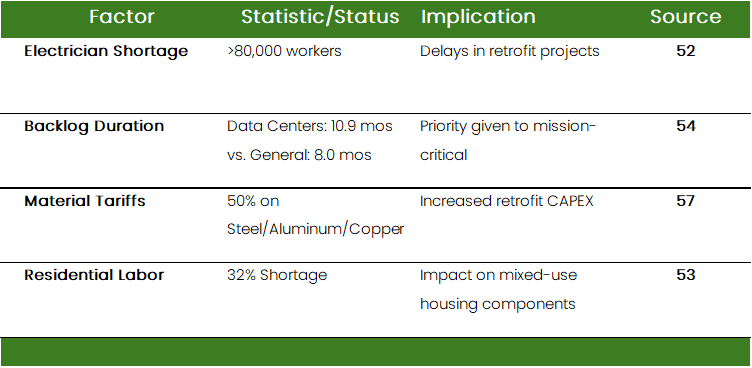
Will the demand for electricians increase? Emphatically yes. The industry faces a severe shortage of over 80,000 electricians nationally.52 This shortage is driven by the "perfect storm" of infrastructure modernization, the green energy revolution (solar/EVs), and the retirement of the Baby Boomer generation (22% of tradespeople are over 55).52
7.2 Expanding Backlogs and the "Data Center Effect"
Will electrical contracting backlogs expand? Yes, but unevenly. The "Data Center Effect" is absorbing a massive percentage of the skilled labor force.
Backlog Dynamics: Contractors serving the data center market report significantly longer backlogs (10.9 months) compared to general commercial contractors (8.0 months).54
Competition for Labor: General office retrofits will compete for labor against mission-critical data center projects and federally funded infrastructure work. This is likely to drive up labor costs and extend project timelines for standard office renovations. Contractors are increasingly selective, favoring projects with established scale.55
7.3 Tariff Impacts on Material Costs
Geopolitical trade policies introducing tariffs on steel, aluminum, and copper (up to 50% in some scenarios) are expected to inflate material costs in 2026.57
Copper: As the primary conductor for electrification (EVs, heat pumps, data centers), copper is particularly sensitive. Tariffs combined with high demand could lead to price volatility, impacting the budget for electrical retrofits.57
Project Viability: These cost increases—estimated to add thousands of dollars per unit in residential and scaling significantly for commercial projects—may cause some marginal retrofit projects to be paused or value-engineered, forcing designers to look for alternative materials or methods (like Class 4 wireless power) to reduce copper dependency.59
8. Emerging Trends & Future Outlook
8.1 Neuro-Inclusion and "Purposeful Abundance"
Workplace design in 2026 is moving beyond general accessibility to "neuro-inclusion." This involves creating spaces that cater to diverse neurological processing needs—such as hyper-sensitive (needs quiet, low light) and hypo-sensitive (needs stimulation). The trend is toward "purposeful abundance" of choice, offering a menu of environments rather than a uniform open plan.13
8.2 The Global 24/7 Workplace
The concept of the office operating only from 9-to-5 is obsolete. With global teams and asynchronous work, the physical office in 2026 is part of a "24/7 ecosystem." This influences location strategy, favoring mixed-use districts that remain safe and vibrant at 2 AM, and building operations, requiring HVAC and lighting zones that can be activated individually off-hours without powering the whole building.13
8.3 Conclusion
In 2026, workplace design is no longer a discipline of aesthetics but one of infrastructure resilience. The convergence of AI computing needs, climate regulations, and a bifurcated real estate market is forcing a radical upgrade of the built environment.
The pace of retrofitting will accelerate, but it will be constrained by the availability of skilled electrical labor and the capacity of the power grid. The "winners" in 2026 will be assets that can deliver "firm power" (reliability), "agentic support" (AI readiness), and "human-centric" environments (neuro-inclusion) simultaneously. As the office market bifurcates, the divide will not just be between the new and the old, but between the intelligent, electrified, and compliant assets and those left stranded by the regulatory and technological tide.
9. Tabular Data and Statistics Overview
Table 1: Projected U.S. Office Market Metrics (2026)
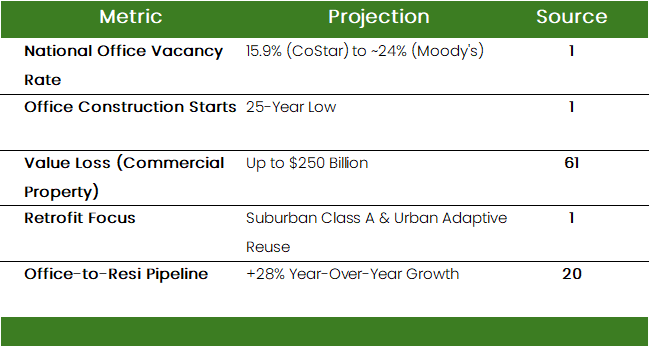
Table 2: AI Infrastructure & Power Trends
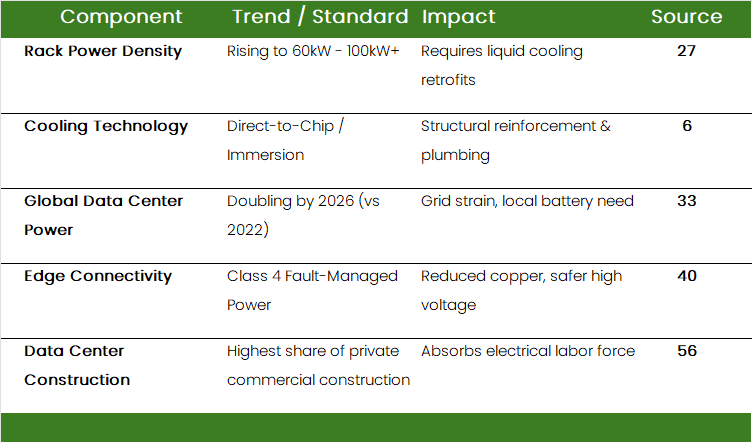
Table 3: Key Regulatory & Code Compliance Events (2026)
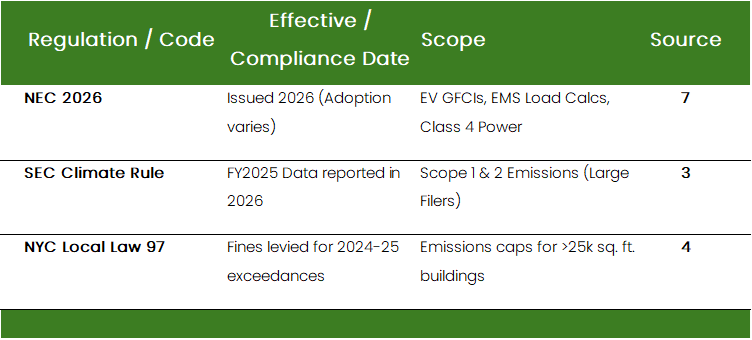
Table 4: Labor & Industry Constraints
Works cited
2026 Office Outlook - Marcus & Millichap, accessed December 7, 2025, https://www.marcusmillichap.com/research/research-brief/2025/11/research-brief-november-2026-office-outlook
The State Of The U.S. Office Real Estate Market Heading Into 2026 - Forbes, accessed December 7, 2025, https://www.forbes.com/councils/forbesbusinesscouncil/2025/10/08/the-state-of-the-us-office-real-estate-market-heading-into-2026/
Even without SEC Climate Rules, U.S. Companies May Still Need to Disclose GHG Emissions in 2026 | Publications | Cleary Gottlieb, accessed December 7, 2025, https://www.clearygottlieb.com/news-and-insights/publication-listing/even-without-sec-climate-rules-us-companies-may-still-need-to-disclose-ghg-emissions
LL97 Greenhouse Gas Emissions Reduction - Buildings - NYC.gov, accessed December 7, 2025, https://www.nyc.gov/site/buildings/codes/ll97-greenhouse-gas-emissions-reductions.page
Designing for AI: How Built Environments Can Support On-Premise Intelligence - HGA, accessed December 7, 2025, https://hga.com/designing-for-ai-how-built-environments-can-support-on-premise-intelligence/
Latest Trends in Liquid Cooling Technology for AI Data Centers in 2025 - ByteBridge, accessed December 7, 2025, https://www.bytebt.com/trends-liquid-cooling-ai-data-centers-2025/
NEC 2026 explained: Stay ahead of the curve - Schneider Electric Blog, accessed December 7, 2025, https://blog.se.com/energy-management-energy-efficiency/2025/11/06/nec-2026-explained-stay-ahead-of-the-curve/
Breaking Down the 2026 NEC: Why DIY EV Charger Installs Face an Uncertain Future, accessed December 7, 2025, https://www.apexmechanicalbg.com/breaking-down-the-2026-nec-why-diy-ev-charger-installs-face-an-uncertain-future
Commercial property vacancy rate to peak in 2026 at 24%: Moody's | CFO Dive, accessed December 7, 2025, https://www.cfodive.com/news/commercial-property-vacancy-rate-peak-2026-moodys-CRE-delinquency-real-estate/720234/
Office Recovery Strengthens As Vacancy Drops - CRE Daily, accessed December 7, 2025, https://www.credaily.com/briefs/office-recovery-strengthens-as-vacancy-drops/
United States Outlook 2026 | US - Cushman & Wakefield, accessed December 7, 2025, https://www.cushmanwakefield.com/en/united-states/insights/united-states-outlook
26 Workplace Design Trends and Ideas for 2026 | Future-Proof Your Office Design with RI Workplace, accessed December 7, 2025, https://riworkplace.com/26-workplace-design-trends-and-ideas-for-2026/
10 Workplace Trends for 2026: What's In and What's Out? - Gensler, accessed December 7, 2025, https://www.gensler.com/blog/10-workplace-trends-for-2026-whats-in-and-whats-out
US cities sharpen focus on building performance standards to meet net-zero goals, accessed December 7, 2025, https://www.facilitiesdive.com/news/us-cities-building-performance-standards-net-zero-emissions/722404/
SEC Adopts Climate Change Disclosure Rules; Court Imposes Temporary Stay, accessed December 7, 2025, https://www.whitecase.com/insight-alert/sec-adopts-climate-change-disclosure-rules-court-imposes-temporary-stay
Which Cities Would Benefit Most from Converting Offices into Housing? | Urban Institute, accessed December 7, 2025, https://www.urban.org/urban-wire/which-cities-would-benefit-most-converting-offices-housing
US vacancy rate of commercial buildings sits at nearly 40-year high - Moody's, accessed December 7, 2025, https://www.moodys.com/web/en/us/insights/data-stories/us-commercial-real-estate-vacancies-downtown-vs-suburbs.html
The Suburban CRE Playbook: Preparing for 2026 and Beyond, accessed December 7, 2025, https://commercial.suburbancitygroup.com/the-suburban-cre-playbook-preparing-for-2026-and-beyond/
Construction Pipelines Remain Sluggish as Office Utilization Patterns Continue to Settle - CommercialCafe, accessed December 7, 2025, https://www.commercialcafe.com/blog/national-office-report/
Where Office-to-Resi Conversions Are Growing Most—and Why - Multi-Housing News, accessed December 7, 2025, https://www.multihousingnews.com/where-are-office-to-resi-conversions-growing-most-and-why/
10 Key AI Workforce Trends In 2026 - Gloat, accessed December 7, 2025, https://gloat.com/blog/ai-workforce-trends-2/
TA Trends 2026: Human–AI Power Couple | Full Report - Korn Ferry, accessed December 7, 2025, https://www.kornferry.com/insights/featured-topics/talent-recruitment/ai-in-recruitment-trends
AI for Acoustic Design | Smarter Sound Absorption Panels, accessed December 7, 2025, https://polyxwall.com/2025/07/14/how-ai-is-shaping-the-future-of-sound-absorption-panels/
Soundscaping: How Architects Shape Social Wellbeing Through Acoustics, accessed December 7, 2025, https://www.asiarchitectural.com/how-architects-shape-social-wellbeing-acoustics/
SOUNDSCAPE PERSONALISATION AT WORK: DESIGNING AI-ENABLED SOUND TECHNOLOGIES FOR THE WORKPLACE - SMC Network, accessed December 7, 2025, https://smcnetwork.org/smc2024/papers/SMC2024_paper_id117.pdf
2026 Workforce Outlook: Employers That Prioritize AI Literacy and Education Benefits Can Lead the Talent Race - Business Wire, accessed December 7, 2025, https://www.businesswire.com/news/home/20251204575337/en/2026-Workforce-Outlook-Employers-That-Prioritize-AI-Literacy-and-Education-Benefits-Can-Lead-the-Talent-Race
White Paper: Redesigning the Data Center for AI Workloads - Raritan, accessed December 7, 2025, https://www.raritan.com/landing/redesigning-data-center-for-ai-workloads-white-paper/thanks
Disrupting data centre design - KPMG International, accessed December 7, 2025, https://kpmg.com/ie/en/insights/strategy/disrupting-data-centre-design-strategy.html
The Future is Liquid: How In-Rack and Direct-to-Chip Cooling are Revolutionizing Data Centers - CyrusOne, accessed December 7, 2025, https://www.cyrusone.com/resources/blogs/in-rack-and-direct-to-chip-cooling-revolutionizing-data-centers
Thermal Management For Data Centers 2026-2036: Technologies, Markets, and Opportunities - IDTechEx, accessed December 7, 2025, https://www.idtechex.com/en/research-report/thermal-management-for-data-centers/1128
Data Center Physical Security: Key Standards, Best Practices - Avigilon, accessed December 7, 2025, https://www.avigilon.com/blog/data-center-physical-security
Physical security of a data center - International Society of Automation (ISA), accessed December 7, 2025, https://www.isa.org/intech-home/2020/march-april/departments/physical-security-of-a-data-center
As generative AI asks for more power, data centers seek more reliable, cleaner energy solutions - Deloitte, accessed December 7, 2025, https://www.deloitte.com/us/en/insights/industry/technology/technology-media-and-telecom-predictions/2025/genai-power-consumption-creates-need-for-more-sustainable-data-centers.html
The Future of Energy Storage: 2026 and Beyond - Astra Canyon Group, accessed December 7, 2025, https://www.astracanyon.com/blog/the-future-of-energy-storage-2026-and-beyond
Eight energy trends that will shape energy storage in 2026, accessed December 7, 2025, https://www.energy-storage.news/eight-energy-trends-that-will-shape-energy-storage-in-2026/
Dive into the Top 10 Energy Storage Trends & Innovations [2026], accessed December 7, 2025, https://www.startus-insights.com/innovators-guide/energy-storage-trends/
New Building Codes Take Effect Jan 1, 2026 | City of Oakland, CA, accessed December 7, 2025, https://www.oaklandca.gov/News-Releases/Planning-Building/New-Building-Codes-Take-Effect-Jan-1-2026
Proposed 2026-2028 Green Building and Local Energy Code Update - City of Palo Alto, accessed December 7, 2025, https://www.paloalto.gov/Departments/Planning-Development-Services/Development-Services/Green-Building/Green-Building-Code-Requirements/Proposed-2026-2028-Green-Building-and-Local-Energy-Code-Update
2026 Trends in Industrial Electrification: Smarter, Cleaner, Faster, accessed December 7, 2025, https://necaibew48.com/blog/industrial-electrification-trends/
Summary of Significant 2026 NEC® Changes, accessed December 7, 2025, https://www.dli.mn.gov/sites/default/files/pdf/boe-101425-summary-nec-changes.pdf
7 Key 2026 NEC Changes Contractors Need To Have on Their Radar, accessed December 7, 2025, https://www.electricalassociation.com/Online/Online/News/Blogs/7_Key_2026_NEC_Changes_Contractors_Need_to_Have_on_Their_Radar.aspx
What is Class 4 Fault Managed Power? | NECA - National Electrical Contractors Association, accessed December 7, 2025, https://www.necanet.org/neca-bicsi/schedule/session-detail/what-is-class-4-fault-managed-power
What to know about 2026 NEC® updates for commercial and industrial buildings, accessed December 7, 2025, https://mbex.org/docs/news/Project_Articles_-_Blog/SDE_NEC_eGuide_2026_R1_082625_CK.pdf
ASHRAE Leads the Way in Public Health Standards with Groundbreaking Resource, accessed December 7, 2025, https://www.ashrae.org/about/news/2023/ashrae-leads-the-way-in-public-health-standards-with-groundbreaking-resource
ASHRAE Takes the Lead In Providing Technical Resources for Controlling Infectious Aerosols, accessed December 7, 2025, https://www.ashrae.org/about/news/2024/ashrae-takes-the-lead-in-providing-technical-resources-for-controlling-infectious-aerosols
Building Standards Commission - DGS (ca.gov), accessed December 7, 2025, https://www.dgs.ca.gov/BSC
Specialized Code | Lexington, MA, accessed December 7, 2025, https://www.lexingtonma.gov/1929/Specialized-Code
Massachusetts Specialized Opt-In Stretch Energy Code | Westborough, MA, accessed December 7, 2025, https://www.town.westborough.ma.us/1226/Massachusetts-Specialized-Opt-In-Stretch
Washington Clean Buildings Standard - Avista Utilities, accessed December 7, 2025, https://www.myavista.com/energy-savings/energy-saving-programs-services-for-your-business/washingtons-new-clean-building-standards
Will 2026 be the Year that Smart Buildings Grow Up? - Allbridge, accessed December 7, 2025, https://allbridge.com/blog/will-2026-be-the-year-that-smart-buildings-grow-up/
Industry Expects Matter Standard to Spur Smart Home Acceptance | ACHR News, accessed December 7, 2025, https://www.achrnews.com/articles/146645-industry-expects-matter-standard-to-spur-smart-home-acceptance
Why Electricians Are in High Demand Heading Into 2026 - South Jersey Electrical Training, accessed December 7, 2025, https://sjelectricaltraining.com/2025/09/10/why-electricians-are-in-high-demand-heading-into-2026/
Residential Contractor Employment Crisis: 2025 Labor Shortage Hits Record 32%, accessed December 7, 2025, https://contractoraccelerator.com/blog/residential-contractor-employment-crisis-2025-labor-shortage-hits-record-32
Due to the federal government shutdown, no monthly construction economic data will be collected and no reports will be issued until sometime after the government reopens. Because ABC will not receive any of the data that the - Associated Builders and Contractors, accessed December 7, 2025, https://www.abc.org/News-Media/News-Releases/abc-construction-backlog-indicator-july-2025
Electrical Industry Growing, Fueled by Acquisitions, Data Centers and More, accessed December 7, 2025, https://www.ecmag.com/magazine/articles/article-detail/electrical-industry-growing-fueled-by-acquisitions-data-centers-and-more
Why Data Center Projects Are Outbidding Traditional Commercial Construction in 2026 - The Birmingham Group, accessed December 7, 2025, https://thebirmgroup.com/why-data-center-projects-are-outbidding-traditional-commercial-construction-in-2026/
The effect of Trump's tariffs on the North American construction industry - PBC Today, accessed December 7, 2025, https://www.pbctoday.co.uk/news/planning-construction-news/the-effect-of-trumps-tariffs-on-the-north-american-construction-industry/156912/
Tariff Resource Center for Contractors - AGC of America, accessed December 7, 2025, https://www.agc.org/tariff-resources-contractors
How Tariffs Impact the Home Building Industry | NAHB, accessed December 7, 2025, https://www.nahb.org/advocacy/top-priorities/building-materials-trade-policy/how-tariffs-impact-home-building
How to incorporate top office design trends in 2026 | Eptura, accessed December 7, 2025, https://eptura.com/discover-more/blog/how-to-incorporate-top-office-design-trends-in-2026/
Moody's Predicts $250 Billion U.S. Office Property Value Loss By 2026 - Allwork.Space, accessed December 7, 2025, https://allwork.space/2024/06/moodys-predicts-250-billion-u-s-office-property-value-loss-by-2026/
2026 NEC Code Changes Every Building Owner Should Know | Schnackel Engineers, accessed December 7, 2025, https://schnackel.com/blogs/2026-nec-code-changes-every-building-owner-should-know
What to know about LEED v5? - UL Solutions, accessed December 7, 2025, https://www.ul.com/insights/what-know-about-leed-v5
LEED v5 is here: last chance to certify your project with LEED v4/4.1 - macro design studio, accessed December 7, 2025, https://www.macrodesignstudio.it/en/2025/11/13/leed-v5-is-here-last-chance-leed-v4-4-1/
About the author
Bob Kroon is a recognized thought leader and innovator with over four decades of experience in the electro-mechanical and furniture industries. As the CEO and founder of August Berres, he envisions overcoming the limitations of traditional building power by enabling the Agile Workplace through a smart power ecosystem.
Bob passionately advocates for technologies such as building microgrids, fault-managed power (FMP), and battery-powered Agile Furniture, which are transforming the design and utilization of commercial spaces. Under his leadership, a suite of innovative solutions has been brought to market, including Respond!, Juce, CampFire, and Wallies. These products empower building owners, architects, and facility managers to retrofit buildings for today’s dynamic work environment.