

From "Nice-to-Have" to "Adapt or Die": The Financial Reality of Sustainability in 2025
By Robert Kroon
Executive Summary
Designing for Sustainability is Designing for Value.
Ten years ago, sustainability in commercial real estate was largely a branding exercise or a niche pursuit for operational cost savings. Today, it has become the single most critical determinant of asset value and liquidity. The market has bifurcated: sustainable, Class A "Trophy" buildings are commanding significant rent premiums and high occupancy, while obsolete "brown" buildings face plummeting valuations and "stranded asset" risk.
For buyers—both investors acquiring properties and tenants signing leases—sustainability is no longer optional; it is a non-negotiable financial imperative driven by regulatory mandates, corporate ESG commitments, and the urgent need for talent retention. Retrofitting existing stock with technologies such as fault-managed power (FMP) and battery-powered Agile Furniture is now the most financially astute strategy to bridge this gap.
The Shift: 2015 vs. 2025
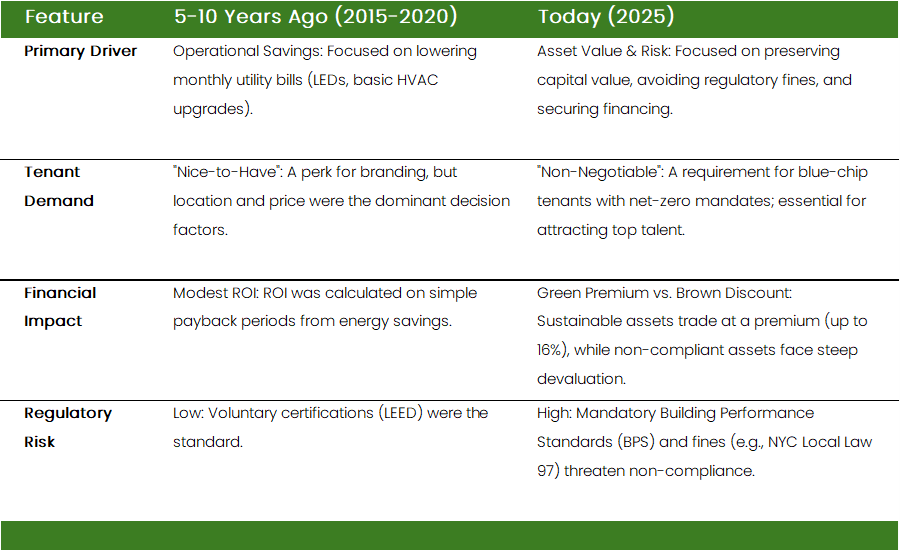
The transformation in buyer sentiment over the last decade is profound. What was once a "value-add" feature has become the baseline for entry into the premium market.
The Financial Reality: Green Premiums and Brown Discounts
The most significant change for buyers today is the emergence of the "Brown Discount." In 2015, an older, inefficient building was simply a "value-add" opportunity. In 2025, it is a liability.
The Green Premium: Data consistently shows that high-performance buildings command higher rents and sales prices. Tenants are willing to pay a premium—often 20% or more—for spaces that align with their ESG goals and offer superior indoor environmental quality.
The Brown Discount: Conversely, buildings that fail to meet modern sustainability standards are seeing their values erode. These assets are increasingly difficult to finance or insure as lenders and investors retreat from "carbon-heavy" portfolios to avoid future regulatory penalties.
The Agile Workplace as a Sustainability Strategy
August Berres Agile Workplaces openly communicate commitments to sustainability helping recruitment and retention
Sustainability today is not just about the building shell; it is about adaptability. A truly sustainable building is one that does not need to be torn apart and rebuilt every time a tenant's needs change. This is where the Agile Workplace becomes a critical tool for asset owners.
Reducing Construction Waste: Traditional renovations involve demolishing walls, ripping out wiring, and sending tons of material to landfills. By retrofitting with battery-powered Agile Furniture and intelligent power solutions, building owners can drastically reduce the embodied carbon of tenant improvements.
Future-Proofing Assets: Products like Respond! desks, CampFire collaboration tables, and Juce mobile monitor stands allow spaces to be reconfigured instantly without construction. This flexibility ensures the building remains relevant and usable for decades, avoiding the cycle of obsolescence.
Efficient Power Delivery: Integrating technologies such as fault-managed power (FMP) and battery-powered Agile Furniture reduces reliance on inefficient AC infrastructure and copper-heavy conduit, aligning the building's electrical backbone with modern energy-efficiency goals.
Conclusion
For buyers in 2025, sustainability is synonymous with financial safety. The "flight to quality" is real, and the capital markets have spoken: green assets are the future, and everything else is a risk. For building owners, the path forward is clear—retrofit, modernize, and embrace agility to unlock value in an increasingly discerning market.
Designing for Sustainability in your project?
Ask us to explain what August Berres can do.
About the author
Bob Kroon is a recognized thought leader and innovator with over four decades of experience in the electro-mechanical and furniture industries. As the CEO and founder of August Berres, he envisions overcoming the limitations of traditional building power by enabling the Agile Workplace through a smart power ecosystem.
Bob passionately advocates for technologies such as building microgrids, fault-managed power (FMP), and battery-powered Agile Furniture, which are transforming the design and utilization of commercial spaces. Under his leadership, a suite of innovative solutions has been brought to market, including Respond!, Juce, CampFire, and Wallies. These products empower building owners, architects, and facility managers to retrofit buildings for today’s dynamic work environment.