

The Copper Cliff: Why Traditional Wiring is Becoming a Financial Liability for Commercial Real Estate
By Robert Kroon
Executive Summary
The global commodity landscape is currently witnessing a fundamental transformation in the strategic valuation of industrial metals, with copper emerging as the central bottleneck for the modern technological era. As the primary conductor for electrification, digital infrastructure, and the renewable energy transition, copper has transitioned from a cyclical industrial metal into a critical strategic asset with high supply-chain risk and a projected long-term structural deficit.1
This shift is occurring against a backdrop of unprecedented demand from artificial intelligence (AI) data centers, national defense spending, and global grid modernization. At the same time, the primary supply from mining stagnates due to declining ore grades and protracted permitting timelines.4
For the commercial real estate sector, these macroeconomic pressures are manifesting as a significant increase in the capital expenditure (CapEx) required for traditional electrical retrofits, thereby enhancing the value proposition for innovative power distribution architectures such as Class 4 Fault-Managed Power (FMP) and battery-powered agile furniture.7
The Macroeconomic Outlook for the Copper Market (2026–2035)
The copper market is navigating an inflection point where short-term cyclical surpluses are being overshadowed by long-term structural scarcities. While the market through 2025 and 2026 may exhibit modest surpluses—estimated by various analysts between 160 kt and 600 kt—the underlying physical fundamentals are tightening at a rate that suggests a return to pre-2024 pricing levels is increasingly unlikely.10
Price Projections and Strategic Volatility
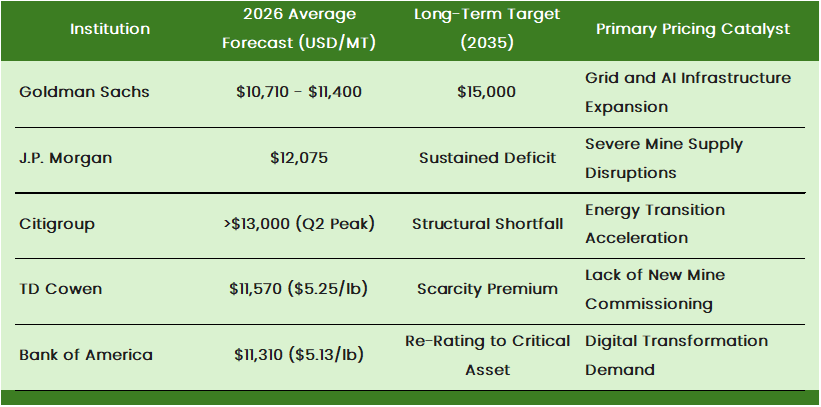
Copper prices have demonstrated extreme sensitivity to geopolitical and macroeconomic triggers in recent years, testing record nominal highs of over $11,700 per ton in late 2025 and even $13,310 per ton in early 2026.10 Industry analysts from Goldman Sachs Research and J.P. Morgan anticipate that while prices may consolidate in the $10,000 to $11,000 range during 2026 as the market digests potential US tariffs and Chinese economic shifts, the long-term trajectory is aggressively bullish.10 By 2035, the London Metals Exchange (LME) price for copper is projected to reach $15,000 per ton, driven by a widening supply gap that will require higher prices to incentivize the development of marginal mining projects.2
The implementation of US tariffs—estimated between 15% and 25% on refined copper—is expected to create regional price premiums and distort global flows, potentially driving COMEX prices to unprecedented premiums over the LME benchmark.6 These policy-driven fluctuations introduce a new layer of risk for construction procurement organizations, which must now pivot from reactive price management to proactive resilience, including the expansion of secondary copper usage and the adoption of material substitution technologies.12
The Impending Structural Shortage
“By 2035, copper production from announced projects is expected to fulfill only 70% of anticipated global demand.”
A systemic risk is emerging from the disconnect between copper demand growth and supply elasticity. S&P Global projects that global copper demand will surge by 50% over the next 15 years, reaching 42 million metric tons by 2040.1 Conversely, existing primary supply from mining is poised to decrease. Without substantial new investment, global primary supply could produce only 22 million metric tons by 2040—one million tons less than current levels.4
The shortage is projected to manifest in earnest by 2029, as demand overtakes supply.10 By 2035, copper production from announced projects is expected to fulfill only 70% of anticipated global demand.12 Even under optimistic recycling scenarios, where scrap supply more than doubles to 10 million metric tons by 2040, a persistent supply deficit of 10 million metric tons—representing 25% of projected demand—is expected to remain.4
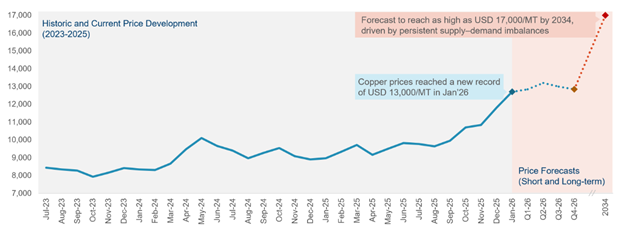
Source: Aranca, aranca.com
Supply-Side Structural Constraints: Geology and Geopolitics
The inability of copper supply to meet burgeoning demand is not a temporary disruption but a reflection of deep-seated structural challenges in the mining sector. These constraints are both geological and regulatory in nature, extending the lead times for new production to unprecedented lengths.
Declining Ore Grades and Production Maturity
One of the most significant factors limiting supply response is the depletion of high-grade ore bodies in mature mining districts such as Chile and Peru. As ageing mines process lower-grade material, the energy and water intensity of production increases, while the metal output per tonne of rock moved decreases.4 Global mine production is expected to peak around 2030 at 33 million metric tons, after which it is projected to decline at a CAGR of 2–3% through 2035.4 This geological reality means that even at record prices, the existing mining infrastructure is physically limited in its ability to ramp up production.
Permitting Timelines and Capital Intensity
The average lead time for a copper project to move from discovery to production now spans 17 to 25 years.1 This timeline is driven by increasingly complex permitting processes, lengthy judicial reviews, environmental opposition, and the necessity of extensive community consultations.1 Furthermore, the capital intensity of new developments has risen sharply; bringing 80 new mines online by 2030 to meet demand would require an estimated $250 billion in investment.15 Resource nationalism and evolving fiscal regimes in major producing countries add further uncertainty to long-term production economics, often deterring the massive, multi-decade capital commitments required for new projects.12
Concentration of Reserves and Refining Dominance
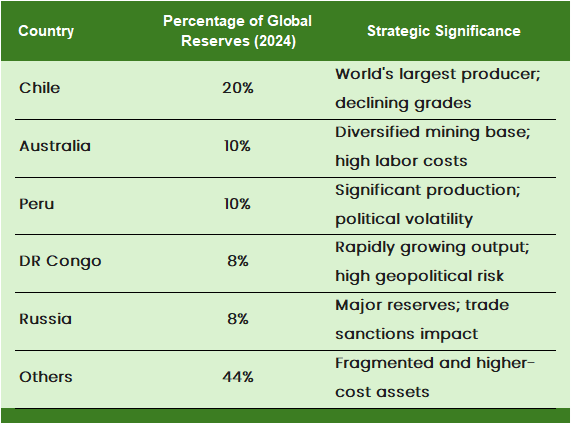
The geopolitical risk to the copper supply chain is increased by the geographic concentration of both reserves and refining capacity. Over 50% of global copper reserves are located in just five countries: Chile, Australia, Peru, the Democratic Republic of the Congo, and Russia.15
Furthermore, the refining of copper has seen a dramatic shift toward Asia, with China now accounting for 60% of global refinery production—a tripling of its share over three decades.15 This dominance in the "first-use" and semi-finished products markets, such as wire and tube production, gives China significant leverage over the global copper value chain. For Western economies, this concentration necessitates "reshoring" efforts and grid upgrades that are themselves copper-intensive, creating a recursive demand loop.1
Demand Disruptors: The Four Vectors of Growth
The surge in copper consumption is driven by a convergence of four distinct but overlapping "vectors" that are fundamentally reshaping the market.1 While traditional construction remains the single largest market, the incremental growth is almost entirely attributed to technological and environmental imperatives.
Artificial Intelligence and the Data Center Explosion
Data centers have emerged as the "volatility wild card" in copper forecasting.5 These facilities are extremely electricity-intensive, with copper being essential for every stage of their power distribution systems, cooling infrastructure, and grid interconnects.1 S&P Global estimates that data centers could account for 14% of total US electricity demand by 2030, up from 5% today.1 A single large-scale data center can require as much as 50,000 tons of copper for its electrical and mechanical systems.7 J.P. Morgan projects that AI-driven data center demand could reach 475 kt of copper annually by 2026, adding a layer of relatively price-inelastic demand to the market.13
The Global Energy Transition
The shift to a net-zero economy is the second major pillar of demand growth. Electric vehicles (EVs) require nearly three times as much copper as conventional internal combustion engine cars, while renewable installations—solar and wind—are significantly more copper-intensive than fossil fuel generation.1 Wood Mackenzie projects that the broader energy transition will require an additional two million tons per annum (Mtpa) of copper supply over the next decade, with EV-related demand set to double by 2035.5
Grid Modernization and Electrification
The expansion of the global power grid to handle the influx of renewable energy and the electrification of heating and transport is the primary driver of demand, projected to account for 60% of copper demand growth until 2030.10 This effort is equivalent to adding "another United States" to global copper demand within the current decade.10 In advanced economies, this involves upgrading aging urban grids, while in emerging economies, it entails building new, smart infrastructure to support rapid urbanization.1
National Defense and Security
Rising geopolitical tensions have led to increased defense budgets globally. Modern defense systems, from munitions to sophisticated electronic warfare platforms, are significant consumers of copper.4 Defense spending is considered a "quiet but meaningful" source of incremental demand that is highly inelastic, as national security priorities often override cost considerations.1
Financial Impact of Copper Costs on Building Retrofits
The transition to a high-copper-cost environment has profound implications for the commercial real estate sector, particularly for building retrofits that rely on traditional electrical distribution methods. The construction industry accounts for 46% of US copper supply, with building wire alone using 20% of the total.2
Traditional AC Wiring: The Cost of Rigid Infrastructure
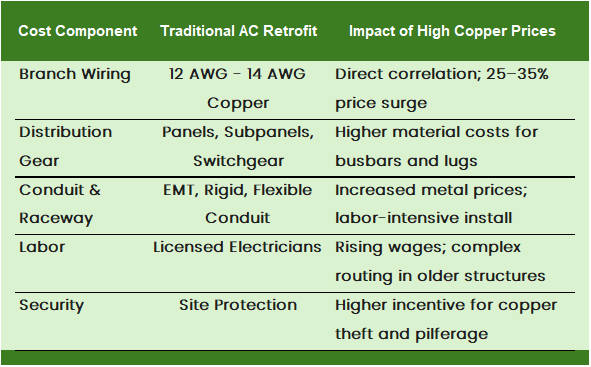
Conventional commercial wiring methods are inherently copper-dependent. Most consultants specify THHN/THWN conductors in 100% copper for branch circuits to ensure conductivity and durability.19 The financial impact of copper price fluctuations is "outsized" because there is often no alternative material specified for these circuits in traditional designs.2
When copper prices cross the $5/lb. threshold, construction budgets are often "devastated," leading to frequent re-estimations and project delays.2
The volatility of copper pricing also shortens bid validity windows, forcing contractors to include higher risk premiums in their estimates.8
Furthermore, high prices increase the incentive for "insider pilferage" (liberal end-cutting) and site theft, which is estimated to account for up to 8% of wiring loss in new construction.2
Quantifying Copper Intensity in Commercial Spaces
“Retrofitting a 35,000-square-foot office space for basic lighting and outlets can cost between $210,000 and $310,500, with copper materials comprising a substantial portion of the direct costs.24”
The weight of copper in a traditional retrofit can be mathematically estimated based on the wire gauge and run length. The weight (W) of a copper conductor is a function of its cross-sectional area (A), length (L), and the density of copper (D ~ 8,960 kg/cubic Meter):
W =A * L * D
For a standard commercial branch circuit using 12 AWG copper wire, which has a diameter of approximately 0.0808 inches 21:
12 AWG Weight: Approximately 19.8 lbs (8.98 kg) per 1,000 feet.22
10 AWG Weight: Approximately 31.4 lbs (14.24 kg) per 1,000 feet.22
In a large office building, the cumulative weight of copper across thousands of feet of branch wiring, coupled with heavy-gauge feeders for HVAC and lighting, represents a massive and volatile financial liability.20 Retrofitting a 35,000-square-foot office space for basic lighting and outlets can cost between $210,000 and $310,500, with copper materials comprising a substantial portion of the direct costs.24
Shifting Strategy to Fault-Managed Power (Class 4)
Fault-Managed Power (FMP) represents a revolutionary departure from traditional electrical distribution. Formally adopted as Article 726 in the 2023 National Electrical Code, Class 4 power systems utilize sophisticated circuit management to ensure that the energy delivered into any fault is limited, thereby mitigating fire and shock hazards.25
Technical Architecture and Safety Mechanisms

August Berres battery systems can be charged using fault-managed power.
FMP systems, such as VoltServer's Digital Electricity (DE), transmit power in discrete packets.26 A transmitter continuously monitors the line—often thousands of times per second—checking for faults such as short circuits or human contact.29 If a fault is detected, the system halts power delivery in less than 4 milliseconds.26 This proactive safety approach differs from Class 2 systems, which limit power output at the source (100W maximum), and Class 1/AC systems, which rely on physical containment (conduit) and breakers.25
The technical advantages of FMP include:
Higher Power/Distance: Delivers up to 2,000W over distances exceeding 1,000 meters—nearly 20 times the power and 10 times the distance of PoE.25
DC Distribution: Efficiently distributes high-voltage DC (up to 450V), eliminating the 20% energy loss typical of AC-to-DC conversions in digital devices.27
Smaller Conductors: Utilizes lighter, smaller-gauge wires (such as 18 AWG) because safety is managed electronically rather than through physical wire size or conduit.25
Comparative Material Costs: FMP vs. Traditional AC
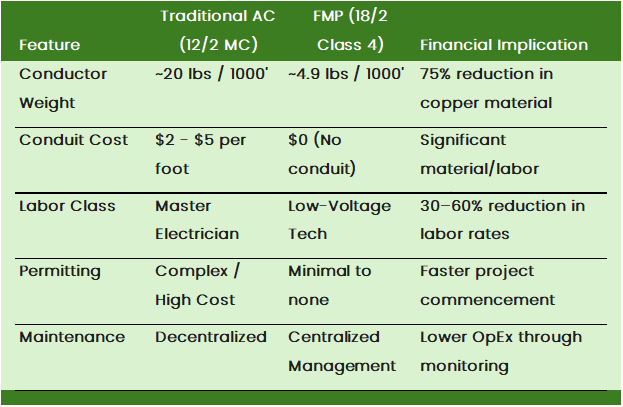
The financial advantage of FMP is primarily realized through the reduction of "copper intensity" and the elimination of mechanical protection. Because Class 4 systems are inherently safe, they do not require conduit and can be installed using Ethernet-like wiring methods.25
In a 10-story office building retrofit, switching to an FMP-based infrastructure can reduce total copper usage by an estimated 4,348 lbs.33
This reduction in copper dependency creates a significant hedge against the projected $15,000/ton copper price, as the "material beta" of an FMP retrofit is drastically lower than that of a traditional AC installation.2
Labor Dynamics and Installation Velocity
FMP systems install 40% faster than traditional electrical distribution.31 The ability to route "skinny" DE cables through communication ducts, risers, and trash chutes without the need for structural modifications or core drilling reduces the time of deep-energy retrofits from months to weeks.26 A case study of a commercial office retrofit demonstrated a 30% reduction in total installed cost for FMP systems compared to traditional AC.34 These savings are amplified when the labor market for skilled electricians is tight, as FMP can be installed by workers using standard low-voltage techniques.29
Agile Workplaces and the Economy of Mobile Power
The transition toward "Agile Workplaces" reflects a shift in organizational culture toward flexibility, collaboration, and high-velocity work processes.35 Central to this shift is the decoupling of the worker from fixed building infrastructure, particularly the "floor box" electrical outlet.37
The Hidden Costs of the Floor Box
The location of floor boxes and perimeter outlets dictates traditional office layouts. Installing these outlets in existing buildings involves core drilling through concrete slabs, which is not only expensive—costing hundreds of dollars per location—but also permanent.38 A single large-capacity floor box assembly (box plus cover) can cost over $600 in materials alone, and a typical training room with eight such locations represents a $5,000 investment before labor is even factored in.40
When an organization needs to reconfigure for a new "Scrum" team or a collaborative "Design Sprint," the logistical hurdles posed by these fixed outlets often prevent the necessary movement, sacrificing the "flow state" for convenience.41 This results in underutilized space; research at Steelcase found that individual workstations and meeting rooms are often occupied less than 30% of the time.35
Battery-Powered Furniture as a Financial Catalyst
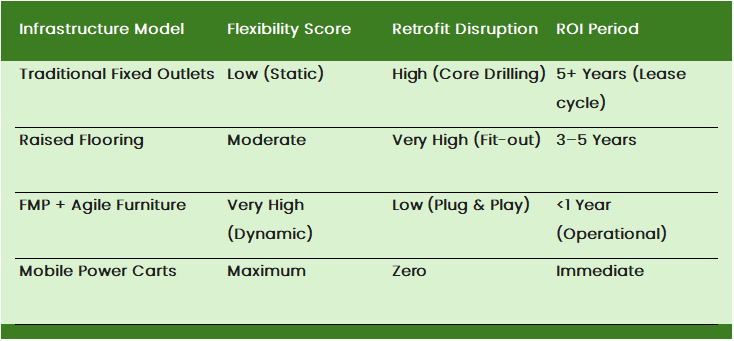
Mobile power solutions, such as the August Berres Juce, integrate high-capacity battery units into the furniture.9 These units can power multiple devices (MacBooks, displays, mobile whiteboards) for an entire shift, allowing furniture to be moved effortlessly across the floor.37
The ROI of battery-powered agile furniture is driven by:
Zero Tenant Improvements (TI): Buildings can be retrofitted without costly core drilling or trenching, making them "Zero TI" electrical assets.9
Asset Mobility: Investments in battery-powered furniture move with the business when it relocates, unlike fixed wiring, which is a sunk cost in the landlord's building.9
Improved Team Velocity: Agile teams in flexible spaces have shown a 40% improvement in work completion (velocity) within just two sprint cycles.35
Space Efficiency: Transitioning to agile environments allows businesses to optimize physical space, potentially reducing the total square footage required by 20–30%.43
Synthesis: How Future Copper Costs Shape the Value Proposition
The relationship between the projected cost of copper and the value proposition for FMP and Agile Workplaces is one of inverse correlation. As the "cost of rigid infrastructure" rises due to copper scarcity, the relative attractiveness of "material-lean" digital power systems increases.
The Breakdown of Traditional Economics
Historically, the decision to use FMP was often driven by a desire for advanced controls or the need to overcome physical constraints in historic buildings.9 However, as copper prices move toward the projected $15,000/ton milestone, the financial burden of the copper conductors themselves becomes the dominant decision factor.2 In a traditional AC system, copper represents a major portion of the raw material cost; in an FMP system, the copper content is reduced by 75%, shifting the value toward the "intelligence" of the power electronics.25
Second-Order Effects: Energy and Labor
The value proposition is further bolstered by energy efficiency. DC-powered buildings can save approximately 30% of energy by avoiding inefficient AC-to-DC conversions.9 In a high-utility-cost environment, this OpEx saving complements the CapEx saving from reduced copper usage.9
Furthermore, the "perfect storm" of rising material costs and tight labor markets favors technologies that can be installed by a broader pool of workers.8 The ability of FMP to be deployed by low-voltage technicians—who are generally more available and lower-cost than master electricians—provides a critical operational advantage in a volatile economy.29
Strategic Conclusions

Designing battery-powered Agile Workplaces from August Berres avoids much of the impact of rising copper prices.
The strategic re-rating of copper is transforming it from a commodity into a strategic bottleneck for the global economy. For the commercial real estate sector, this implies that the "status quo" of electrical distribution is no longer financially viable for the next decade of development. The projected shortages of 10 million metric tons by 2040 and the resulting price volatility will act as a primary catalyst for the mass adoption of Fault-Managed Power and Agile Workplace solutions.2
Buildings that continue to rely on extensive, copper-heavy fixed infrastructure will face higher maintenance costs, longer retrofit timelines, and lower tenant retention in a market that increasingly values flexibility and digital integration.38 Conversely, properties equipped with FMP backbones and battery-powered agile furniture will offer a superior value proposition: lower CapEx, higher operational efficiency, and the ability to adapt to the rapidly changing needs of the AI-driven workforce.9 The transition to a "low-copper" infrastructure is not merely an environmental preference; it is a structural necessity for maintaining project viability and competitive advantage in the 2030s.
Works cited
S&P Global: Copper Becoming One of the World's Most Strategic Commodities | INN, accessed January 24, 2026, https://investingnews.com/sp-global-coppers-strategic-value/
What Does $5/lb Copper Mean for the Building Wire Market? - Copperweld, accessed January 24, 2026, https://www.copperweld.com/blog/what-does-5-lb-copper-mean-for-the-building-wire-market
Copper To Become the Global Economy's Most Critical Asset in 2026 - Article | Crux Investor, accessed January 24, 2026, https://www.cruxinvestor.com/posts/copper-to-become-the-global-economys-most-critical-asset-in-2026
'Substantial Shortfall' in Copper Supply Widens as the Race for AI ..., accessed January 24, 2026, https://press.spglobal.com/2026-01-08-Substantial-Shortfall-in-Copper-Supply-Widens-as-the-Race-for-AI-and-Growing-Defense-Spending-Add-to-Accelerating-Demand,-New-S-P-Global-Study-Finds
soaring copper demand an obstacle to future growth | Wood Mackenzie, accessed January 24, 2026, https://www.woodmac.com/press-releases/soaring-copper-demand-an-obstacle-to-future-growth/
Copper Trends 2025: Market Outlook, Shortages, and Pricing | Admiralty Industries, accessed January 24, 2026, https://admiraltyindustries.com/blog/copper-trends-2025-understanding-value-scarcity-and-the-road-ahead/
Tariffs Add New Pressure to Commercial Construction Budgets - Cushman & Wakefield, accessed January 24, 2026, https://ir.cushmanwakefield.com/news/press-release-details/2025/Tariffs-Add-New-Pressure-to-Commercial-Construction-Budgets/default.aspx
Metal Price Volatility Squeezes Projects Amid Data Center Boom - ConstructConnect News, accessed January 24, 2026, https://news.constructconnect.com/metal-price-volatility-squeezes-projects-amid-data-center-boom
General 6 — August Berres battery-powered Agile Workplaces, accessed January 24, 2026, https://www.augustberres.com/agile-workplace-news
Copper Prices Are Forecast to Decline Somewhat from Record ..., accessed January 24, 2026, https://www.goldmansachs.com/insights/articles/copper-prices-forecast-to-decline-from-record-highs-in-2026
Why Record-High Copper Prices Aren't Forecast to Last | Goldman Sachs, accessed January 24, 2026, https://www.goldmansachs.com/insights/articles/why-record-high-copper-prices-arent-forecast-to-last
Copper at an Inflection Point – Market Volatility and Resilience to 2030 - Aranca, accessed January 24, 2026, https://www.aranca.com/knowledge-library/articles/procurement-research/copper-market-inflection-point-volatility-2030
Copper Market Outlook | J.P. Morgan Global Research, accessed January 24, 2026, https://www.jpmorgan.com/insights/global-research/commodities/copper-outlook
High copper prices persist in early 2026 - Project Blue, accessed January 24, 2026, https://projectblue.com/blue/news-analysis/1400/high-copper-prices-persist-in-early-2026
Copper supply crunch threatens energy and digital transitions - UNCTAD, accessed January 24, 2026, https://unctad.org/news/copper-supply-crunch-threatens-energy-and-digital-transitions
Global Trade Update (May 2025): Focus on critical minerals – copper in the new green and digital economy - UNCTAD, accessed January 24, 2026, https://unctad.org/publication/global-trade-update-may-2025-critical-minerals-copper
The role of copper in the energy transition - DNV, accessed January 24, 2026, https://www.dnv.com/article/the-role-of-copper-in-the-energy-transition-247342/
What Does $5/lb Copper Mean for the Building Wire Market? - PR Newswire, accessed January 24, 2026, https://www.prnewswire.com/news-releases/what-does-5lb-copper-mean-for-the-building-wire-market-302151531.html
Back to basics: Commercial building wiring methods - Consulting - Specifying Engineer, accessed January 24, 2026, https://www.csemag.com/back-to-basics-commercial-building-wiring-methods/
Commercial Electrical Wiring Cost Per Square Foot, accessed January 24, 2026, https://electricalestimating.us/commercial-electrical-wiring-cost-per-square-foot/
Electrical Wire Gauges - HyperPhysics, accessed January 24, 2026, http://hyperphysics.phy-astr.gsu.edu/hbase/Tables/wirega.html
AWG Copper Wire Gauge Chart, accessed January 24, 2026, https://wovenwire.com/reference/AWG-copper-wire-gauge-chart.htm
WIRE WEIGHTS PER 1000 FEET (IN POUNDS ), accessed January 24, 2026, https://colonialwire.com/wp-content/uploads/2013/09/WIRE-WEIGHTS1.pdf
Electrical Cost per Square Foot for Commercial Buildings: Analysis - Caudill's, accessed January 24, 2026, https://caudills.com/electrical-cost-per-square-foot-commercial-buildings/
A Closer Look at Class 4 Fault-Managed Power Systems in Smart Buildings - TIA Online, accessed January 24, 2026, https://tiaonline.org/a-closer-look-at-class-4-fault-managed-power-systems-in-smart-buildings/
How Digital Electricity® - VoltServer, accessed January 24, 2026, https://voltserver.com/wp-content/uploads/2025/08/VS-White-Paper-DE-enables-Low-Disruption-for-Data-Centers.pdf
Digital Electricity vs. Digital Current Class 4 Power Systems | Cence Power, accessed January 24, 2026, https://www.cencepower.com/blog-posts/what-is-digital-electricity-class-4-power
The 5 S's of Fault-Managed Power Systems (FMPS) Change the Power Game - Belden, accessed January 24, 2026, https://www.belden.com/blog/5-game-changer-benefits-of-fault-managed-power-systems
How Fault-Managed Power Cuts Labor and Material Costs in Smart ..., accessed January 24, 2026, https://cleantechnica.com/2025/11/12/how-fault-managed-power-cuts-labor-and-material-costs-in-smart-complexes/
VoltServer™ Digital Electricity - Vicor Corporation, accessed January 24, 2026, https://www.vicorpower.com/resource-library/case-studies/voltserver
VoltServer's Digital Electricity for AI Data Centers, accessed January 24, 2026, https://voltserver.com/wp-content/uploads/2025/08/VS-Data-Center-Brief.pdf
Electrification White Paper - VoltServer®, accessed January 24, 2026, https://voltserver.com/electrification-white-paper/
Get Ready! Class 4 FMP Systems Will Change Technology Design - DBR, accessed January 24, 2026, https://www.dbrinc.com/get-ready-class-4-fmp-systems-will-change-technology-design/
Final Report - VoltServer, accessed January 24, 2026, https://voltserver.com/wp-content/uploads/2024/04/Whitepaper-SBIR-Phase-II-Final-Report.pdf
Transforming IT at Steelcase: An Agile Case Study | IWE inc, accessed January 24, 2026, https://iwe-inc.com/transforming-it-at-steelcase-an-agile-case-study/
Agile case studies: From successful projects 2024 - KVY TECH, accessed January 24, 2026, https://kvytechnology.com/blog/software/agile-case-studies/
Work Untethered - Steelcase, accessed January 24, 2026, https://www.steelcase.com/research/articles/topics/hybrid-work/power-team-anywhere/
Mobile and integrated power as a modern workplace trend - Penketh Interiors, accessed January 24, 2026, https://penkethgroup.com/knowledge-centre/mobile-integrated-power-modern-workplace-trend/
Mobile, Battery-Powered Monitor Stands - August Berres, accessed January 24, 2026, https://www.augustberres.com/power-in-power-out
Question About Floor Boxes for Data & Power : r/electricians - Reddit, accessed January 24, 2026, https://www.reddit.com/r/electricians/comments/uabctv/question_about_floor_boxes_for_data_power/
Agile Office Layouts: Using Mobile Desks for Scrum Teams - Eureka Ergonomic, accessed January 24, 2026, https://eurekaergonomic.com/blogs/eureka-ergonomic-blog/agile-office-layouts-mobile-desks-scrum-teams
An Agile Case Study - Research + Engagement - Steelcase, accessed January 24, 2026, https://www.steelcase.com/research/articles/agile-case-study-research-engagement/
Why Mobile Workstations Are Key to Agile and Flexible Work Environments, accessed January 24, 2026, https://www.newcastlesys.com/blog/why-mobile-workstations-are-key-to-agile-and-flexible-work-environments
Mobile Offices: The Ultimate Guide to Portable Workspaces - MicroFlex Space, accessed January 24, 2026, https://microflexspace.com/mobile-office-spaces/
Cost Comparison: Versatile Office Trailer vs. A Traditional Office, accessed January 24, 2026, https://versatileofficetrailers.com/versatile-office-trailers-vs-traditional-office-spaces-a-cost-comparison/