

Building for Tomorrow: Future-Proofing Your Asset for the 6G and 7G Eras
By Robert Kroon
The pace of technological change often feels relentless, but for building owners and architects, it presents a unique opportunity. While Wi-Fi 7 (Gen 7) is revolutionizing "last mile" connectivity today, the next generations of cellular technology—6G (expected 2030) and 7G (anticipated 2040)—are already on the horizon.
These shifts aren't just about faster internet; they are fundamental transformations that will redefine how buildings are managed and valued. For forward-thinking stakeholders, the goal is to create a more profitable, valuable, and tenant-friendly asset by leading with Agile Workplaces.
In the evolving landscape of digital infrastructure, Gen 7 refers to the seventh generation of wireless standards—most notably Wi-Fi 7 (802.11be), which has officially reached finalization and adoption in late 2025. While 7G cellular is still a futuristic concept, Wi-Fi 7 is currently transforming how we design and manage the modern built environment.
For asset owners and developers, Gen 7 is less about "faster internet" and more about creating a more profitable, valuable, and tenant-friendly asset. By leading with Agile Workplaces—environments that adapt in real-time to user needs—Gen 7 allows you to maximize the financial performance of your square footage.
Key Features of Gen 7 (Wi-Fi 7)
The technical leaps in Gen 7 are designed to handle the high-density data demands of modern "last mile" connectivity within smart buildings.
Multi-Link Operation (MLO): Allows devices to send and receive data across multiple frequency bands (2.4 GHz, 5 GHz, and 6 GHz) simultaneously. This eliminates the "bottleneck" effect, ensuring stable connections even in crowded common areas.
320 MHz Ultra-Wide Channels: This doubles the channel width of previous generations, acting like an "8-lane highway" for data, which is essential for high-fidelity 3D modeling and real-time collaboration tools.
4K-QAM (Quadrature Amplitude Modulation): A sophisticated method of "packing" more data into each signal. It provides a 20% increase in peak data rates compared to Gen 6, translating to faster response times for building management systems (BMS).
Multi-RU (Resource Unit) Puncturing: This allows the network to "skip over" interference within a channel rather than blocking the whole channel, maintaining high performance in environments with many competing signals.
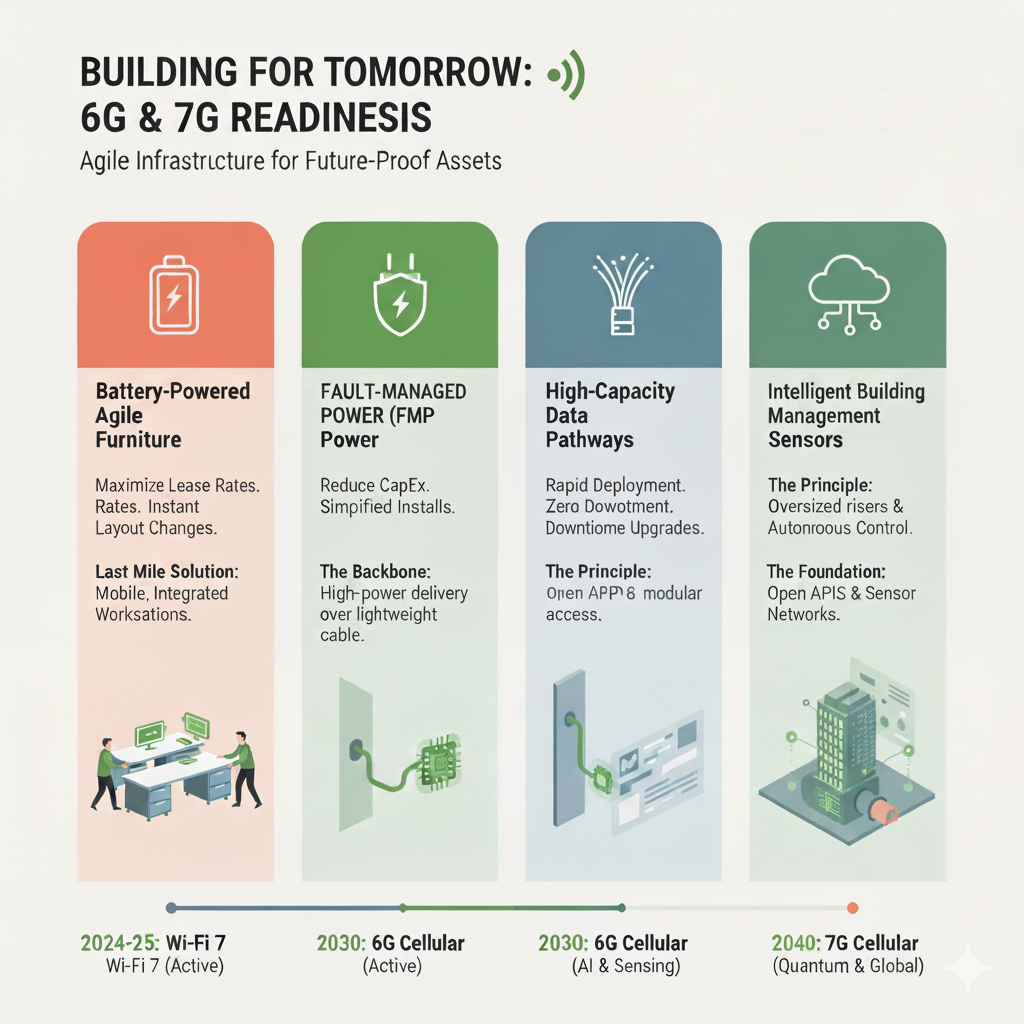
The Foundation: Understanding 6G and 7G for Office Workplaces
To prepare, we must understand the high-density data and power demands these future wireless standards will place on the built environment:
6G: The Dawn of Ubiquitous AI (Expected 2030)
6G is designed to be the backbone for ubiquitous Artificial Intelligence and advanced integrated sensing.
Key Features: Terahertz (THz) frequencies for 1 TBps speeds and Integrated Sensing and Communication (ISAC), where the network itself acts as a high-resolution sensor.
Office Benefit: Hyper-personalized environments that adapt in real-time to individual tenant needs, and predictive maintenance that eliminates downtime.
7G: The Era of Quantum Connectivity (Anticipated 2040)
7G will push boundaries further by integrating quantum technologies and space-based connectivity.
Key Features: Quantum-secure encryption and "Cognitive Networks" that are self-optimizing and self-healing.
Office Benefit: Unrivaled global connectivity and truly autonomous building intelligence, making the asset "self-aware."
Strategic Decisions Today: Agility as the Ultimate Asset
The roadmap to 6G and 7G requires a shift away from rigid, permanent infrastructure. The overarching principle is to move toward modular, "last mile" solutions.
1. Lead with Agile Workplaces and Battery-Powered Furniture
The physical layout of the office must match the agility of future networks. By implementing battery-powered Agile Furniture, you eliminate the need for fixed floor boxes and core drilling.
The Benefit: Tenants can reconfigure their floor plan in minutes to accommodate new 6G hardware. This flexibility is a major differentiator for attracting high-growth firms and maximizing lease rates.
The "Last Mile" Solution: Using mobile, battery-integrated workstations ensures that as wireless standards evolve, your physical infrastructure doesn't have to.
2. Transition to Fault-Managed Power (FMP)
Future wireless access points and edge computing nodes will be far more numerous. Traditional cabling is inefficient for this density. Fault-Managed Power (FMP), such as Class 4 power, is the superior solution for the next generation of buildings.
Safety and Efficiency: FMP monitors for faults and shuts off power in milliseconds if a problem is detected, allowing for high-power delivery over lightweight, low-voltage style cabling.
Reduced CapEx: Because FMP is safe to touch, it can be installed without the heavy conduit required for legacy systems. This makes the "last mile" of your building’s power grid as agile as the Wi-Fi.
Seamless Integration: FMP is the ideal backbone for the dense 6G/7G radio heads that will need to be distributed every few meters throughout a ceiling plenum.
“To enable really nice environmental conditions, you need a high-tech building... It’s partly a fundamental technology thing that the building has to be capable of creating these environments. Why would anyone go to a physical office unless it’s a better experience and enables them to do what they want to do better than anywhere else?”
3. Fiber-to-the-Edge Readiness
Newer frequencies (THz) have shorter ranges, meaning your building will need more "access nodes" closer to the user.
Oversize Pathing: Design for accessible vertical risers and horizontal pathways that allow for the rapid deployment of dark fiber.
The Goal: Ensure that when 6G arrives in 2030, you can pull the necessary fiber to every corner of the floor plate without disrupting tenant operations.
4. Digital Twin and Sensor Integration
6G and 7G thrive on real-time data. By installing a comprehensive sensor network today, you are "teaching" your building how to communicate.
Open API Architecture: Ensure your lighting, HVAC, and security systems speak a common language. This allows future 6G-enabled AI to integrate and control your building autonomously, significantly lowering OpEx.
Conclusion: Future-Proofing for Profitability
The transition from Wi-Fi 7 to 6G and 7G is a call to action. By moving away from fixed infrastructure and embracing technologies such as fault-managed power (FMP) and battery-powered Agile Furniture, you aren't just preparing for a tech update—you are creating a resilient, adaptable asset.
An agile building is a valuable building. By solving the "last mile" challenges of power and connectivity today, you ensure your property remains the preferred choice for tenants for the next two decades.
About the author
Bob Kroon is a recognized thought leader and innovator with over four decades of experience in the electro-mechanical and furniture industries. As the CEO and founder of August Berres, he envisions overcoming the limitations of traditional building power by enabling the Agile Workplace through a smart power ecosystem.
Bob passionately advocates for technologies such as building microgrids, fault-managed power (FMP), and battery-powered Agile Furniture, which are transforming the design and utilization of commercial spaces. Under his leadership, a suite of innovative solutions has been brought to market, including Respond!, Juce, CampFire, and Wallies. These products empower building owners, architects, and facility managers to retrofit buildings for today’s dynamic work environment.