

From Tethered to Transformational: Future-Proofing the Classroom for the AI Era
By Robert Kroon
The question is no longer if laptops are prevalent in classrooms, but how our physical infrastructure can survive the environments they now inhabit.
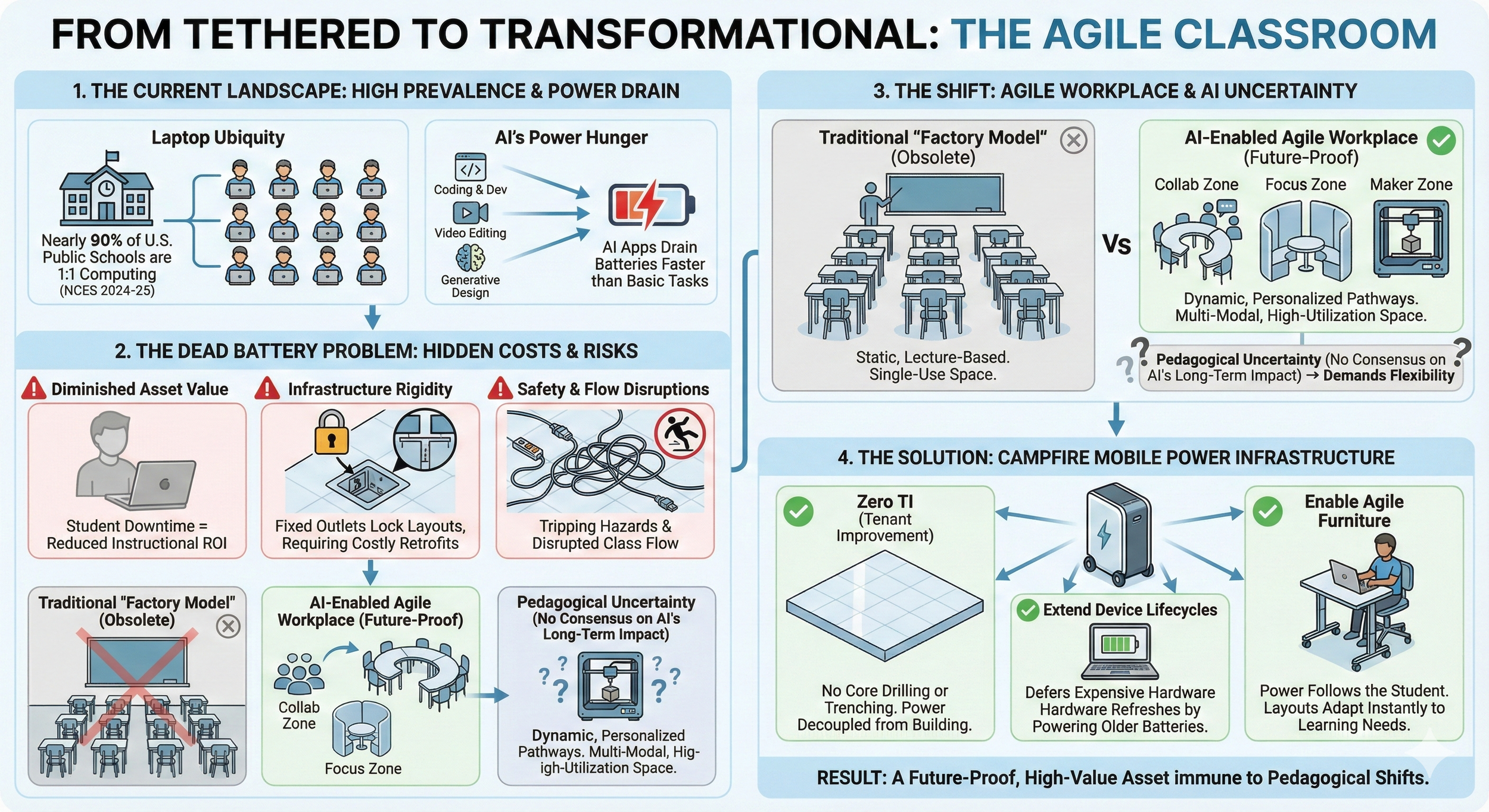
The era of one-to-one computing is fully established. According to National Center for Education Statistics data for the 2024–2025 school year, nearly 90% of U.S. public schools now operate 1:1 computing programs. This is a massive leap from the 53% of K-8 students reported just a decade ago. While this ubiquity has democratized access to information, it has introduced a critical operational challenge: the "power tether."
As pandemic-era funding sunsets, schools face a "funding cliff." The strategic focus must shift from simply acquiring devices to maximizing the value of the physical asset—the classroom itself. A room lined with students tethered to wall outlets is not an asset; it is a bottleneck.
The AI Catalyst: Breaking the Factory Model
We must stop viewing classrooms as static storage for desks and start viewing them as Agile Workplaces. This shift is being accelerated by Artificial Intelligence.
AI is not just a software update; it is a catalyst that is fundamentally breaking the "factory model" of education. Because AI enables hyper-personalized learning, the physical classroom must shift from a static container for instruction to a dynamic environment.
The Death of the "Front of the Room": AI-driven adaptive learning allows 30 students to pursue 30 different learning paths simultaneously. The teacher’s role shifts from "sage on the stage" to "facilitator in the field." This demands de-centered layouts—classrooms that can morph from lecture halls to project studios and back to testing centers within a single day.
The Infrastructure Gap: AI applications—particularly those involving video editing, real-time coding, and generative design—are resource-intensive. They drain device batteries significantly faster than simple word processing. In a standard classroom, students effectively become tethered to the few available wall outlets when batteries die, creating dead zones in the center of the room.
Uncertainty is the Only Certainty
There is almost no consensus on the long-term impact of AI on learning. We are in a period of intense controversy. Some argue AI is a "force multiplier" that unblocks critical thinking; others fear it causes "cognitive offloading," where students skip the struggle necessary for deep learning.
For facility managers and educational leaders, this lack of consensus represents a significant strategic risk: How do you build physical infrastructure for a pedagogy that changes every semester?
If you build a static lecture hall, you lose if the trend shifts to project-based learning.
If you build a rigid computer lab, you lose if the trend shifts to tablet-based mobile AR.
The only way to mitigate the financial risk of this pedagogical uncertainty is to invest in Agile Furniture. By decoupling the furniture from the building, you create an asset that remains valuable regardless of which side of the AI debate wins.
The Hidden Cost of the Dead Battery
In this volatile environment, the dead laptop battery is not just a nuisance; it is a financial and operational liability.
Diminished Asset Value: When a student’s laptop dies, they become an observer rather than a participant. This "downtime" reduces the ROI of both the device and the instructional time.
Infrastructure Rigidity: To combat dead batteries, many schools historically resorted to expensive core drilling or trenching to add floor boxes. This locks furniture into place, reducing the functional square footage of the room and turning the real estate into a depreciating asset that cannot adapt to future needs.
Safety and Flow: Trailing extension cords are a tripping hazard, and the "search for a socket" disrupts the flow of the class.
The Solution: Unlocking Value with CampFire
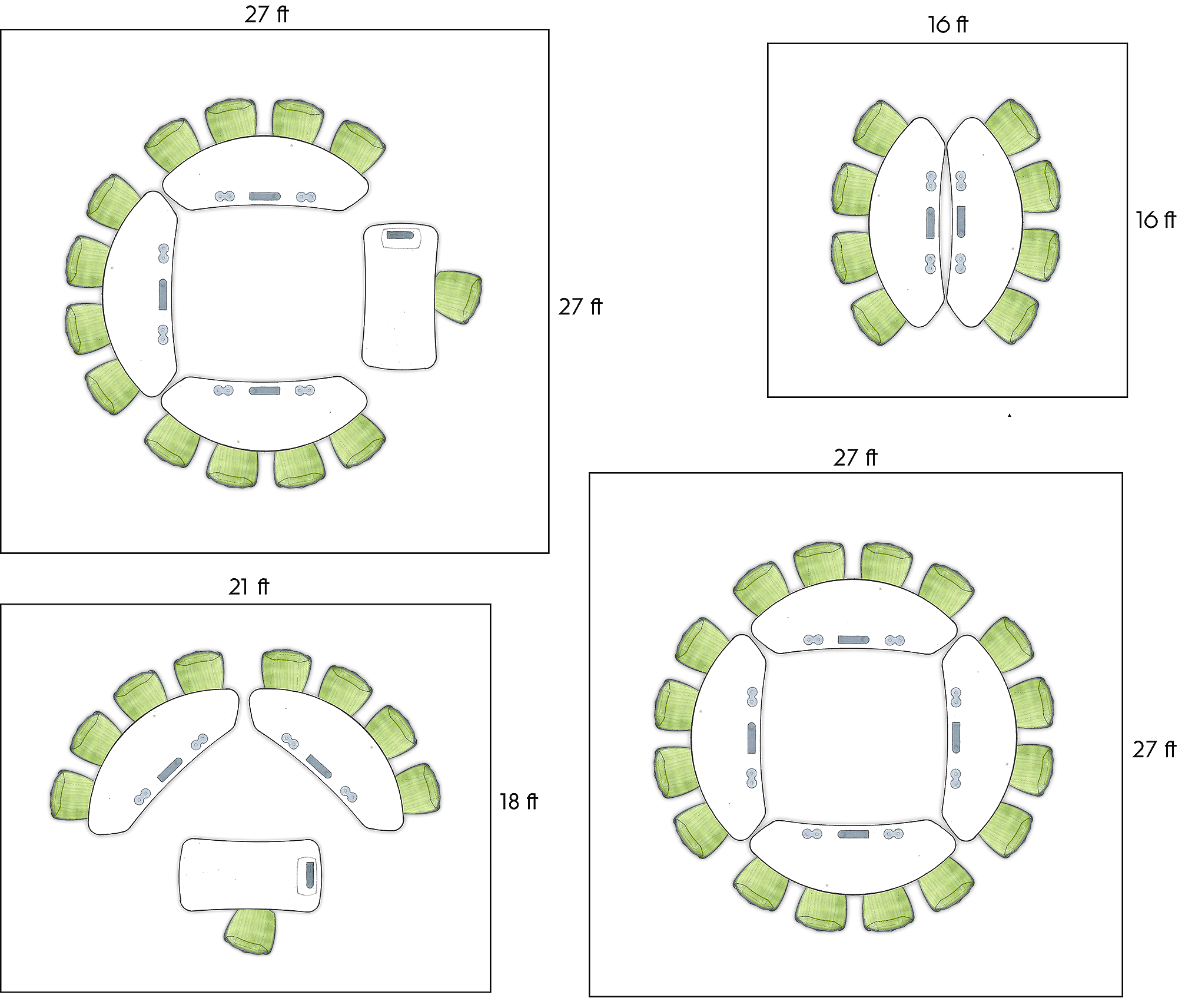
A few of the many possible layouts you can use with CampFire
To create a truly profitable and tenant-friendly asset, facility managers are turning to mobile power infrastructure. The most effective solution for the modern Agile Workplace is CampFire.
CampFire is a supplemental battery system that decouples power delivery from the building’s fixed infrastructure. By deploying CampFire, schools can:
Extend Device Lifecycles: Instead of retiring laptops solely because their internal batteries no longer hold a charge, CampFire provides the necessary power to keep them relevant, deferring expensive hardware refreshes.
Achieve "Zero TI" (Tenant Improvement): CampFire removes the need for costly electrical retrofits. It delivers power right to the desk—wherever that desk happens to be. This allows older, historic, or rigid buildings to support high-tech learning without capital-intensive construction.
Enable Agile Workplaces: Technologies such as fault-managed power (FMP) and battery-powered Agile Furniture are the means to achieve a more compelling end: a flexible environment where the furniture supports the curriculum rather than hindering it.
CampFire uses USB-C connectivity, the universal standard for every laptop sold since 2019. This ensures that regardless of the device brand—Chromebook, MacBook, or PC—the solution remains viable.
Conclusion
Laptops have transformed education, but they have also exposed the limitations of traditional facility design. We cannot afford to let 21st-century learning be held back by 20th-century wiring.
By integrating CampFire and embracing the principles of the Agile Workplace, schools can transform their classrooms into high-value assets. This approach mitigates the risks of technological uncertainty, reduces long-term operational costs, and ensures that learning is never interrupted by a dead battery.
Wondering where AI will take education?
Contact us to discuss classroom solutions that adapt.
About the author
Bob Kroon is a recognized thought leader and innovator with over four decades of experience in the electro-mechanical and furniture industries. As the CEO and founder of August Berres, he envisions overcoming the limitations of traditional building power by enabling the Agile Workplace through a smart power ecosystem.
Bob passionately advocates for technologies such as building microgrids, fault-managed power (FMP), and battery-powered Agile Furniture, which are transforming the design and utilization of commercial spaces. Under his leadership, a suite of innovative solutions has been brought to market, including Respond!, Juce, CampFire, and Wallies. These products empower building owners, architects, and facility managers to retrofit buildings for today’s dynamic work environment.